
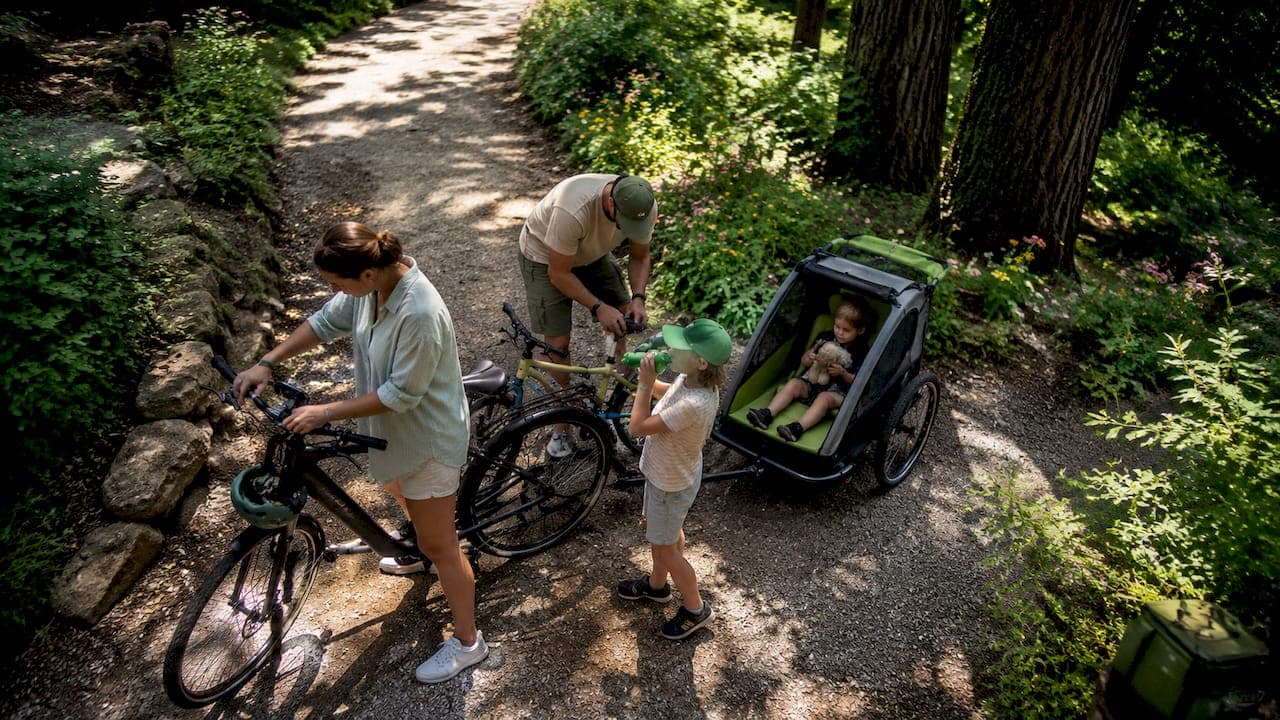
Family bike tour distances are planned by matching daily mileage to a child's age, travel mode, terrain, and the time needed for stops. A six-year-old on a Trailgator tag-along and a twelve-year-old on a full bike require completely different daily targets. The standard industry term for this approach is child-stage distance scaling, and it sits at the center of every well-run family cycling trip. Get it right and the whole trip flows. Ignore it and you'll be pushing bikes uphill with a tired eight-year-old at 3pm.
How bike tour distances are planned for families by age and travel mode
Daily distances scale directly with a child's developmental stage and how they travel. The four main stages are: trailer or cargo seat for children under 5, tag-along bikes for ages 5 to 7, small independent bikes for ages 8 to 11, and full-size bikes for ages 12 and up. Each stage carries a different realistic mileage ceiling.
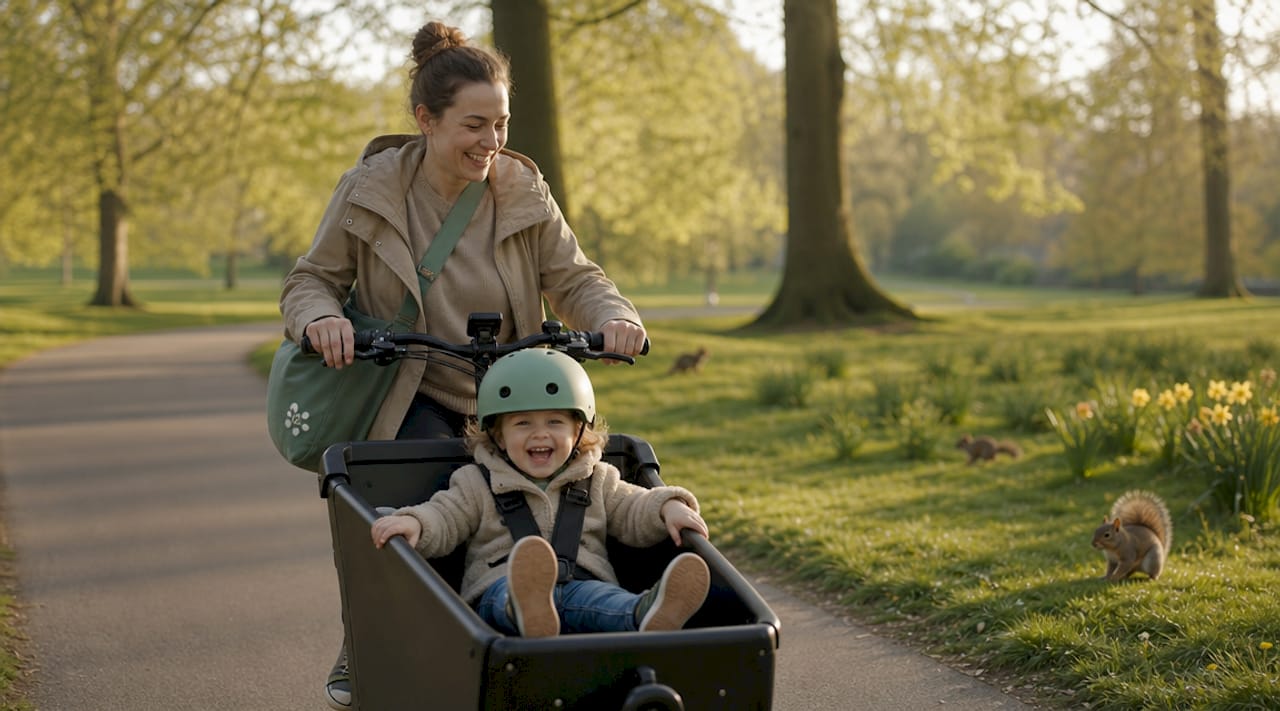
For families with a child in a trailer or cargo seat, the limiting factor is the parent's stamina, not the child's. That extra 20 to 30 kg changes everything on any incline. Tag-along setups, where the child pedals but steers nothing, typically support 25 to 40 km per day. Children on small independent bikes manage a similar range, though they tire faster on rough surfaces. Families where parents ride e-bikes can push toward 40 to 55 km per day because the motor absorbs the extra load and the pace stays comfortable.
| Child stage | Travel mode | Realistic daily distance |
|---|---|---|
| Under 5 | Trailer or cargo seat | 20–35 km (parent-limited) |
| Ages 5–7 | Tag-along bike | 25–40 km |
| Ages 8–11 | Small independent bike | 30–40 km |
| Ages 12–15 | Full bike | 40–55 km (e-bike parents) |
Pro Tip: If your child just moved up a stage, plan the first day at the lower end of the new range. A nine-year-old on their first independent touring day is not the same as a nine-year-old who has been riding for two summers.
The practical implication here is that mixed-age families need to plan to the youngest child's ceiling, not the average. One seven-year-old on a tag-along sets the daily limit for the whole group.
Why elevation matters more than distance on a family cycling trip
Elevation gain is the most underestimated factor in family cycling plans. A flat 30 km day and a hilly 20 km day are not interchangeable. For families towing trailers, a modest climb that a solo cyclist barely notices becomes a genuine physical challenge.
The physics are straightforward. Pulling a 30 kg trailer up even a gentle grade multiplies the effort required. Children on tag-alongs contribute some pedaling, but they also add wind resistance and weight. Small children on independent bikes often stop pedaling on climbs entirely, which means the group stops too. These micro-delays compound quickly across a full day.
Tools like Komoot and OS Maps let you check elevation profiles before committing to a route. The numbers to watch are total elevation gain per day, not just peak height. A route with three short climbs totaling 400 meters of gain will exhaust a family far more than the distance figure suggests.
- Check total elevation gain, not just distance, when using any bike tour distance calculator
- Avoid routes with more than 200 meters of gain per day on the first two days of a trip
- Look for river valley routes, which tend to stay flat by design
- Use Komoot's family filter or the EuroVelo network's difficulty ratings to pre-screen routes
- If towing a trailer, treat every 100 meters of elevation gain as equivalent to an extra 5 km of flat riding
Pro Tip: Make your first day the flattest day. Families that start with a hard climb often recalibrate their whole trip downward in ambition. Start easy, build confidence, then tackle the one scenic hill on day three.
How to incorporate time buffers and rest stops in distance planning
The standard planning rule from Alpkit is to take your estimated distance, halve it, then add an hour for stops and slower pacing. It sounds conservative. It is exactly right. Children do not move at adult touring pace, and they stop for reasons adults do not anticipate.
The Shimanami Kaido family cycling plan in Japan offers a useful real-world example. The route covers 70 km in total. Families with children ages 8 to 12 split it across two days and budget 6 to 8 hours per day including stops. That is roughly 35 km of riding spread across a full day of activity. The mileage sounds low. The experience is full.
Rest stops are not just logistical. They are motivational tools. Stops every 10 to 15 km that include something a child actually wants, a playground, an ice cream shop, a viewpoint with a good photo opportunity, boost mood and stamina more reliably than any pep talk. Planning these stops in advance is as important as planning the route itself.
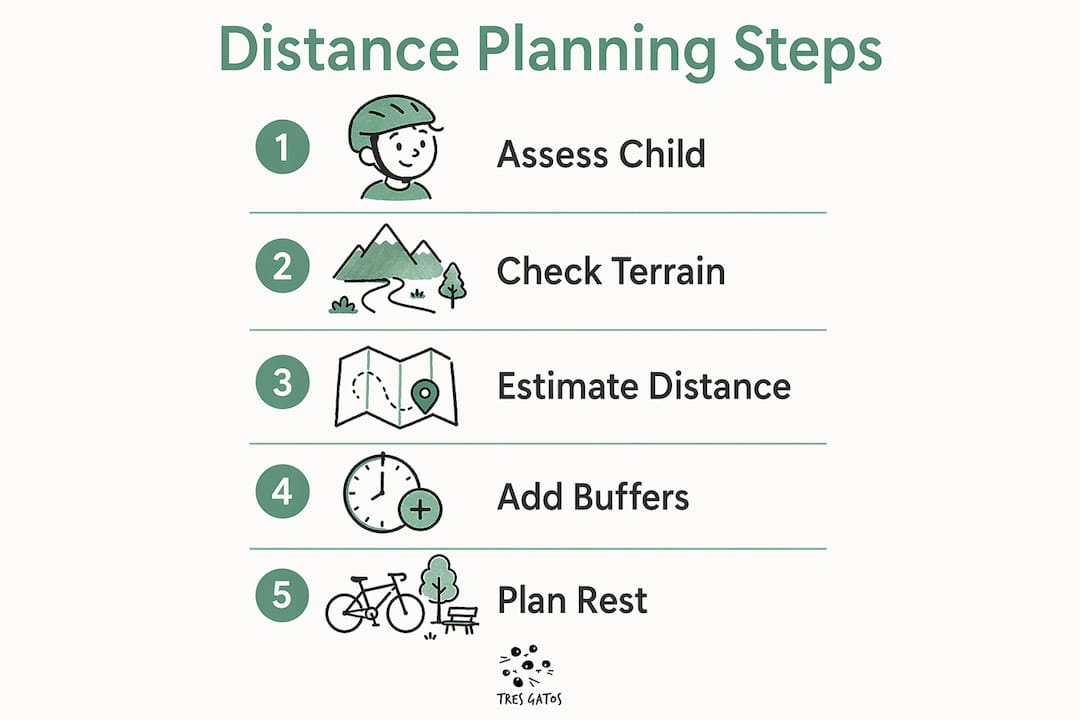
Here is a practical sequence for building a family cycling day:
- Set a distance target based on your child's stage (see the table above)
- Apply the halve-and-add-an-hour rule to get your time budget
- Identify two or three stops that will genuinely interest your children
- Check that each stop is spaced no more than 15 km apart
- Build in a longer midday break of at least 45 minutes, not just a snack stop
- Leave the last hour of the day completely unscheduled as a buffer
Pro Tip: Short days are a design choice, not a failure. A family that arrives at camp at 3pm with energy left for swimming has had a better day than one that limps in at 6pm having covered 20 extra kilometers.
Why breaking routes into stages improves family bike tour success
Long routes become manageable when you divide them into shorter daily segments or organize them as hub-and-spoke day trips from a single base. Both approaches reduce the pressure of linear progress and give families flexibility to adapt when a child is tired or the weather changes.
The Shimanami Kaido plan demonstrates this well. The 70 km island-hopping route includes ferry shortcuts that families with very young children can use to skip sections entirely. The route is designed so that midpoint breaks create natural emotional resets, improving stamina and morale across the full trip. Families do not feel like they failed by taking the ferry. They feel like they made a smart call.
The Drau Cycle Path in Austria offers a different model. Families base themselves in one town and do day trips along the path, returning each evening. This removes the logistical complexity of moving luggage daily and lets children sleep in the same bed each night, which matters more than most adults expect.
| Strategy | Best for | Key benefit |
|---|---|---|
| Linear stages | Older children, point-to-point routes | Sense of progress and achievement |
| Hub-and-spoke day trips | Younger children, mixed ages | Stability, no daily packing |
| Ferry or transport shortcuts | Long routes with young children | Flexibility without abandoning the route |
The emotional dimension of staging is real. A family that reaches a midpoint town, has lunch, and sees the second half of the route as a fresh start will ride better in the afternoon than one grinding through a single long day. Stage breaks at logical midpoints are not a concession to weakness. They are how experienced family tourers structure every trip.
How route selection keeps planned distances safe and achievable
Route choice determines whether your planned distances stay achievable or collapse by day two. Flat, traffic-free paths with frequent rest points are the foundation of every successful family cycling trip. The Danube Cycle Path, Rhine Cycle Path, and Loire Valley routes are the most cited examples in Europe for good reason. They follow river valleys, stay mostly flat, and have towns every 10 to 20 km.
Traffic stress affects children differently than adults. A busy road that an adult cyclist finds manageable can genuinely frighten a child, which drains energy and motivation fast. Dedicated cycle paths along low-traffic corridors like EuroVelo 6 remove that stress entirely, which means children arrive at the end of the day less depleted than the distance alone would suggest.
When selecting a route for family-friendly cycling, look for these characteristics:
- Dedicated cycle path or very low motor traffic
- Maximum 200 meters of elevation gain per day for the first half of the trip
- Towns or villages every 10 to 15 km for rest stops and supplies
- Clear signposting so you spend no time navigating and more time riding
- At least one child-specific attraction per day (castle, beach, playground, market)
Paris and Barcelona both have low-traffic cycling corridors that make city-based family rides genuinely comfortable. The key is knowing which streets and paths to use, which is where a local guide earns their place.
Key takeaways
Family bike tour distances work best when they are built around the youngest child's travel mode, the day's elevation profile, and a realistic time budget that includes stops.
| Point | Details |
|---|---|
| Scale distance to child's stage | Tag-alongs support 25–40 km per day; full bikes with e-bike parents reach 40–55 km. |
| Elevation beats distance | A hilly 20 km day is harder than a flat 30 km day, especially when towing a trailer. |
| Halve your estimate, add an hour | This buffer rule accounts for stops, slower pace, and the unexpected. |
| Stage breaks are core design | Midpoint stops reset energy and morale; they are not a fallback plan. |
| Choose flat, traffic-free routes | Low-traffic corridors reduce child stress and make planned distances achievable. |
What I've learned from watching families plan these trips
Most families I talk to start with a distance they think sounds reasonable and work backward from there. That is the wrong direction. The right approach is to start with your youngest child's travel mode, set a ceiling from that, then check the elevation profile. Distance is the last number you confirm, not the first.
The terrain surprise catches almost everyone. A family that has done day rides at home on flat paths will underestimate a route with 300 meters of daily gain by a wide margin. I have seen fit adults on good bikes arrive at a campsite two hours late because they did not check the elevation on Komoot before they left. Their kids were fine, actually. It was the parents who were done.
E-bikes change the calculation significantly. A parent on an e-bike towing a trailer can cover the same ground with a fraction of the effort, which means more energy for the afternoon swim and less chance of a tense dinner. If you are on the fence about renting e-bikes for a family tour, stop being on the fence.
The families who have the best trips are the ones who plan around exploration rather than completion. They pick a route with good stops, build in a short day on day two, and give themselves permission to take the ferry if the weather turns. The families who struggle are the ones who set a daily target and treat every deviation as failure. Cycling with children is not a race. It is a very slow, very good way to see a place together.
— Evgeny
Tresgatos city bike tours: built for families
If you want to try family cycling in a city before committing to a multi-day tour, Tresgatos runs three-hour rides in Barcelona, Paris, and Valencia with a single guide who actually lives there. Groups stay at nine people maximum, the pace is set by the group, and e-bikes are available for parents who want them. No hidden costs, no luggage logistics, no route-finding stress.
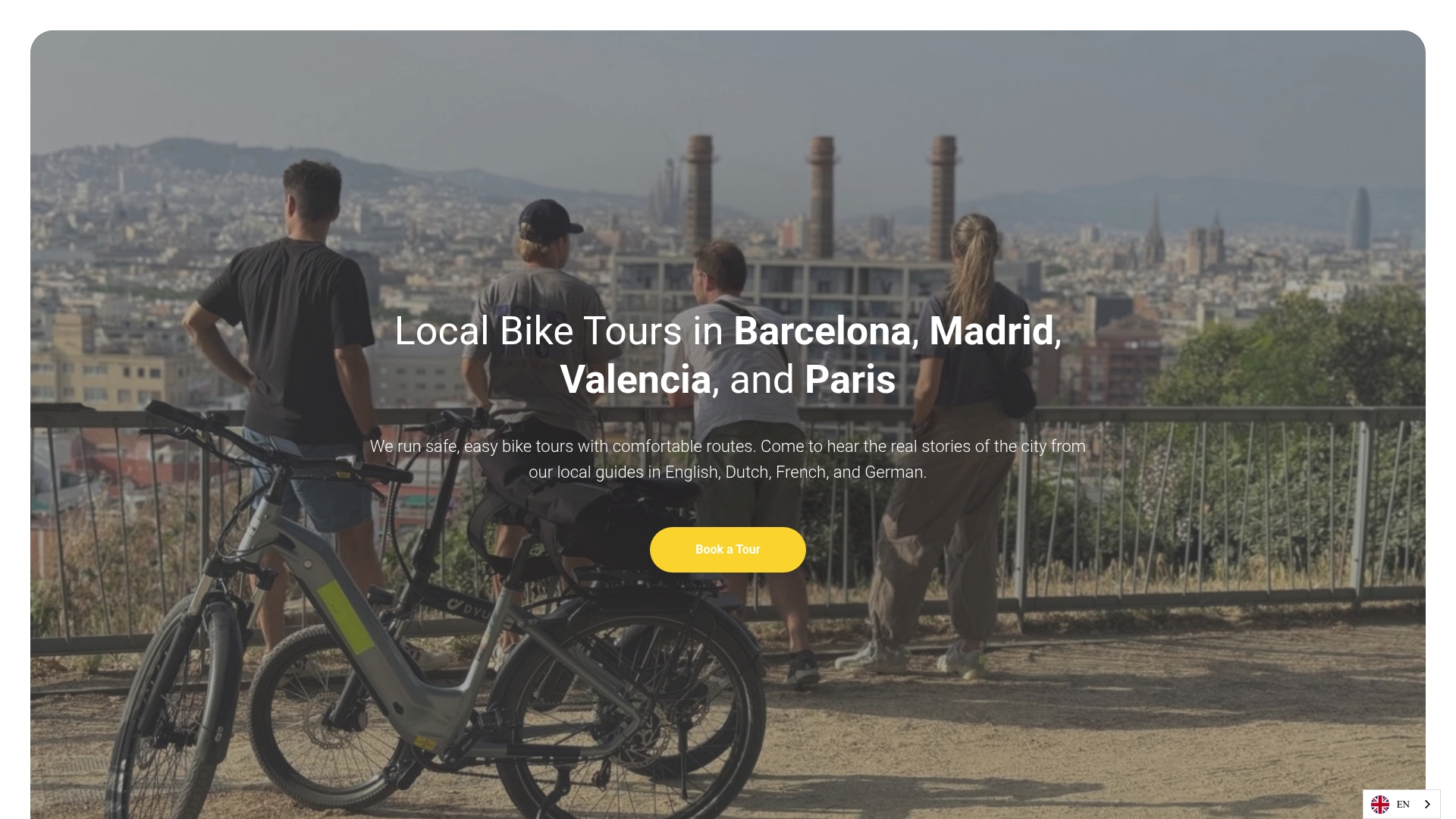
Our guides, Igor in Barcelona, Pierre in Paris, and Marina in Valencia, know which streets are flat, which stops work well with kids, and where to find the ice cream that makes a nine-year-old forget they were tired. If you want to see how family-friendly bike tours work in practice before planning something longer, this is a good place to start. You can also book directly for Barcelona or Paris if you already know where you are headed.
FAQ
What is a realistic daily distance for a family with young children?
Families with children on tag-along bikes or small independent bikes typically cover 25 to 40 km per day. Parents on e-bikes towing trailers can manage 20 to 35 km comfortably, depending on terrain.
How do I account for hills when planning a family bike tour?
Check total elevation gain per day using Komoot or OS Maps, and treat every 100 meters of gain as equivalent to roughly 5 extra flat kilometers. Keep daily elevation gain under 200 meters for the first two days of any trip.
How should I divide a long route into stages for a family?
Split the total route into daily segments of no more than 35 to 40 km, with a longer midday break built in. The Shimanami Kaido model of splitting a 70 km route across two days with 6 to 8 hours of active time per day is a practical benchmark.
What makes a cycling route genuinely family-friendly?
Dedicated cycle paths, flat terrain, towns every 10 to 15 km, and clear signposting are the core criteria. Routes like the Danube Cycle Path and EuroVelo 6 meet all four and are well-suited to family cycling trips with children of mixed ages.
Do e-bikes make a significant difference for family bike touring?
Yes. E-bikes reduce fatigue for parents towing trailers or riding with younger children, which extends the comfortable daily range and leaves more energy for activities after cycling. They are worth considering for any trip longer than two days.