
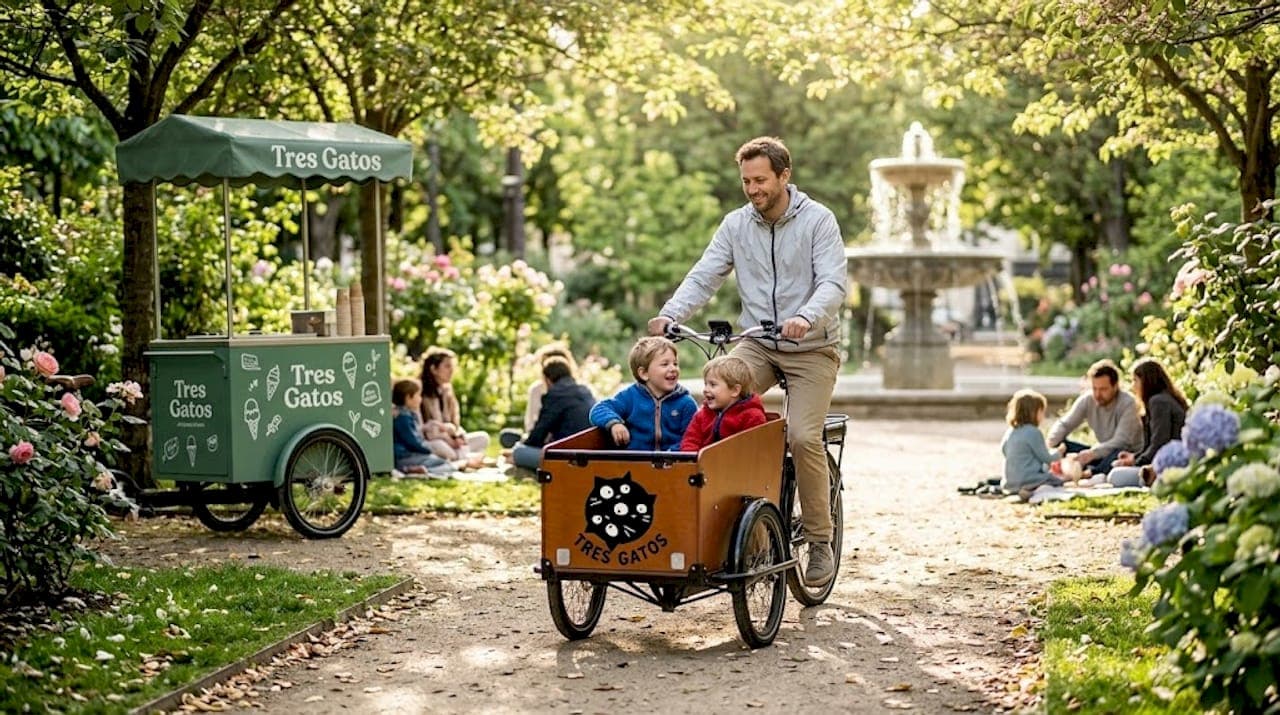
Most families assume Paris is the wrong city for bikes. Too much traffic, too many tourists, too many cobblestones. That assumption is understandable, and it is also outdated. The question of why Paris works for family cycling has a genuinely satisfying answer: the city has spent the last decade methodically rebuilding itself around people on bikes, and a good chunk of that work directly benefits families. Long car-free riverbanks, kid-specific bike-sharing programs, cargo bike rentals built for toddlers, and quiet neighborhood streets make this a city where cycling with children is not just possible. It is often the best way to go.
Table of Contents
- Key Takeaways
- Why Paris works for family cycling
- Choosing the right bike for your family
- Kid-friendly bike sharing in Paris
- Quiet routes and neighborhoods worth exploring
- Safety on the road with kids
- My honest read on Paris for families on bikes
- Explore Paris by bike with Tres Gatos
- FAQ
Key Takeaways
| Point | Details |
|---|---|
| Extensive safe infrastructure | Paris has over 1,000 km of cycling infrastructure, including long car-free riverside routes perfect for families. |
| Right bike makes all the difference | Cargo bikes like the Urban Arrow or Tern GSD handle children of different ages, with electric assist removing any fitness barrier. |
| Kid-focused bike sharing exists | P'tit Velib offers balance bikes to geared bikes for children, with helmets included and stations near parks and museums. |
| Quieter neighborhoods beat tourist routes | Riding through Ménilmontant or along Canal Saint-Martin is safer, more relaxed, and more rewarding than pushing through the Marais. |
| Apps reduce navigation stress | Geovelo in safe route mode builds routes using only protected paths, which matters when you have a six-year-old behind you. |
Why Paris works for family cycling
People who have not been to Paris recently tend to picture it as a city of aggressive traffic and narrow streets. That picture is not entirely wrong, but it describes maybe 20% of the city. The other 80% has changed considerably.
Since 2014, Paris added 300 km of bike lanes, increasing bike-friendly streets by 35%. Cycling trips have now overtaken car trips in the city, which tells you something real about how Parisians actually move around. For families, the most important result of this shift is not the bike lanes themselves. It is the car-free corridors.
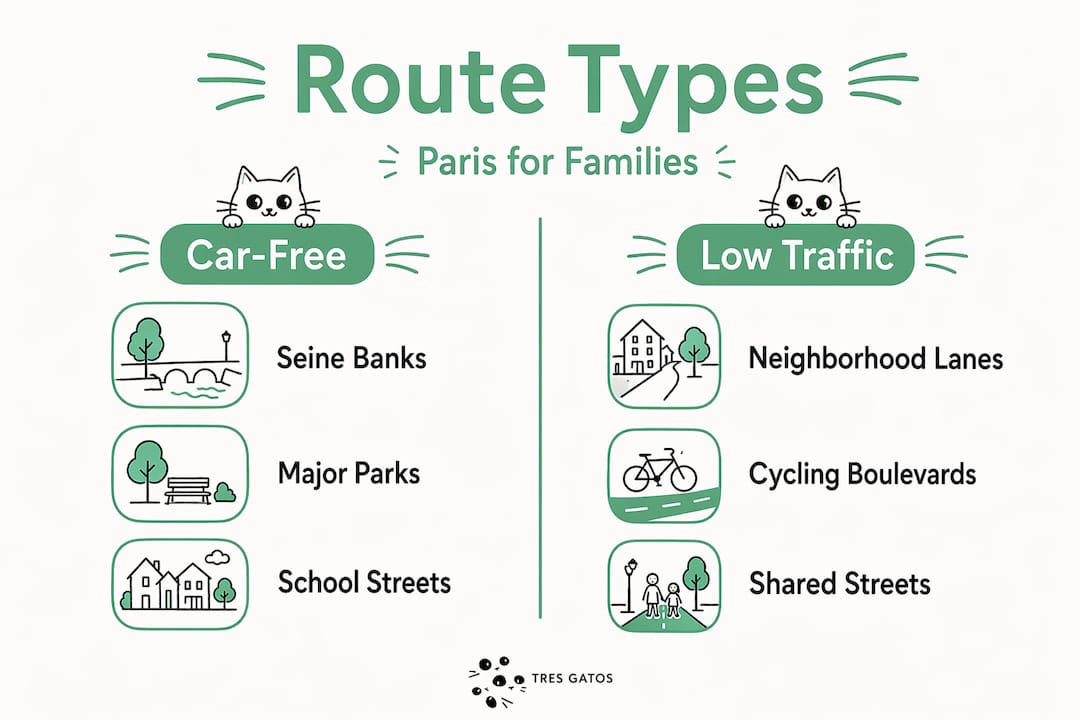
The Seine riverbanks offer 7 km of completely car-free cycling routes along the water, with wide paths, gentle gradients, and consistent shade in summer. A family with two kids aged four and eight can ride from near the Eiffel Tower to the Île Saint-Louis without encountering a single intersection with cars. That is not a small thing.
Paris's broader urban vision under Mayor Hidalgo focuses on 15-minute city planning, making parks, schools, and leisure spaces reachable without a car. The infrastructure consequences for cyclists are direct: separated cycle paths, widened sidewalks beside bike lanes, and calmed traffic in residential areas. Here is a quick overview of what that looks like in practice for a family:
| Route type | Example | Length | Traffic exposure |
|---|---|---|---|
| Car-free riverbank | Seine Left Bank | 7 km | None |
| Protected cycle path | Rue de Rivoli | 3.5 km | Low |
| Park internal paths | Bois de Vincennes | 15+ km | None |
| Greenway | Coulée Verte | 4.5 km | None |
The separated cycle paths matter most for families. When children are riding independently or sitting in a cargo bike box, a physical barrier between them and car traffic changes the feel of the entire outing. Paris has a growing number of these on major axes, and more are being added each year.
Choosing the right bike for your family
The single decision that will most affect your Paris cycling experience is which bike you rent. Get this right and the city opens up. Get it wrong and you spend the day anxious.
For families with children under five, cargo bikes like the Urban Arrow are the standard recommendation. The Urban Arrow Family fits two children in a front box, the children face forward and are visible to the parent at all times, and the electric motor handles any load without effort. For babies as young as three months, Steco infant seat adapters allow very young children to ride facing the parent, which is a meaningful reassurance for cautious parents.
For families with older children who can ride independently but may tire quickly, the Tern GSD is a better fit. It carries one child on a rear seat, folds small enough for tight parking, and handles better in narrower bike lanes than a long-box cargo bike.
| Bike type | Best for | Motor | Child capacity |
|---|---|---|---|
| Urban Arrow Family | Ages 0 to 6 | Electric | Up to 2 children |
| Tern GSD | Ages 4 to 10 (rear seat) | Electric | 1 child |
| Standard e-bike + trailer | Ages 1 to 5 | Electric | 1 to 2 children |
| Standard bike | Children riding independently | None | 0 (plus tagalong option) |
Electric assist cargo bikes require no particular fitness. That matters more than people expect. A parent who has walked 12,000 steps already that day, carrying a toddler and a bag, can still ride 15 km without difficulty. The motor carries you both.
Pro Tip: Book cargo bike rentals at least two to three days in advance, especially in summer. Urban Arrow Family bikes are in high demand, and same-day availability is rare at most Paris rental shops.
Kid-friendly bike sharing in Paris
Paris launched P'tit Velib, a dedicated children's bike-sharing program that runs alongside the adult Velib network. This is not a small gesture. It is a well-thought-out system with over 300 bikes for children in circulation, all with helmets included.
The program offers three bike types, matched to age and skill level:
- Balance bikes for children aged two to four, with no pedals and low seat height
- Training wheel bikes for ages four to six, for children learning to balance while pedaling
- Geared bikes for ages six and up, built for longer distances and varied terrain
Stations connect parks, cultural spaces, and residential squares across the city. A family can pick up bikes near the Jardin du Luxembourg, ride to the Musée d'Orsay, and return the bikes to a station two blocks away. The network is genuinely useful, not just symbolic.
Paris's ecological transformation explicitly targets children as independent urban cyclists, not just passengers. The P'tit Velib program is part of that. Children who use it regularly become comfortable reading bike infrastructure, signaling to traffic, and making decisions on the road. For visiting families, even a single afternoon on P'tit Velib bikes is a memorable activity that your kids will talk about longer than most museum visits.
Pro Tip: P'tit Velib bikes require a subscription card from a Velib station terminal. Bring your credit card and allow 15 minutes for setup before your planned departure time.
Quiet routes and neighborhoods worth exploring
There is a real difference between riding with your family through the Marais on a Saturday afternoon and riding through Ménilmontant on the same day. Both are Paris. One will make you want to go home.
Experienced visitors advise cycling away from tourist corridors when riding with children, and the quieter alternatives offer something the crowded spots cannot: the actual texture of Parisian daily life. Ménilmontant, in the 20th arrondissement, has wide side streets, a strong multicultural food scene, and far less foot traffic than the central tourist zones. Children can actually ride at a comfortable speed without constant stops.
Some of the best family cycling routes in Paris that avoid the crowds:
- Canal Saint-Martin path: 4.5 km along a tree-lined canal, with low traffic crossings and plenty of café stops. Perfect for a morning ride.
- Coulée Verte René-Dumont: An elevated greenway built on a former railway line, running through the 12th arrondissement with zero car crossings.
- Bois de Vincennes: 15 km of internal park paths, two lakes, a zoo, and a medieval castle. Half a day disappears here without effort.
- Promenade Plantée west section: Quieter than the eastern Coulée Verte, this section passes through calm residential streets with good bike infrastructure.
Cycling through Ménilmontant on a Sunday morning, you pass Vietnamese bakeries, West African grocery stores, and neighbors sitting outside with coffee. It is Paris the way people who live here know it, and it takes about 20 minutes by bike from the city center.
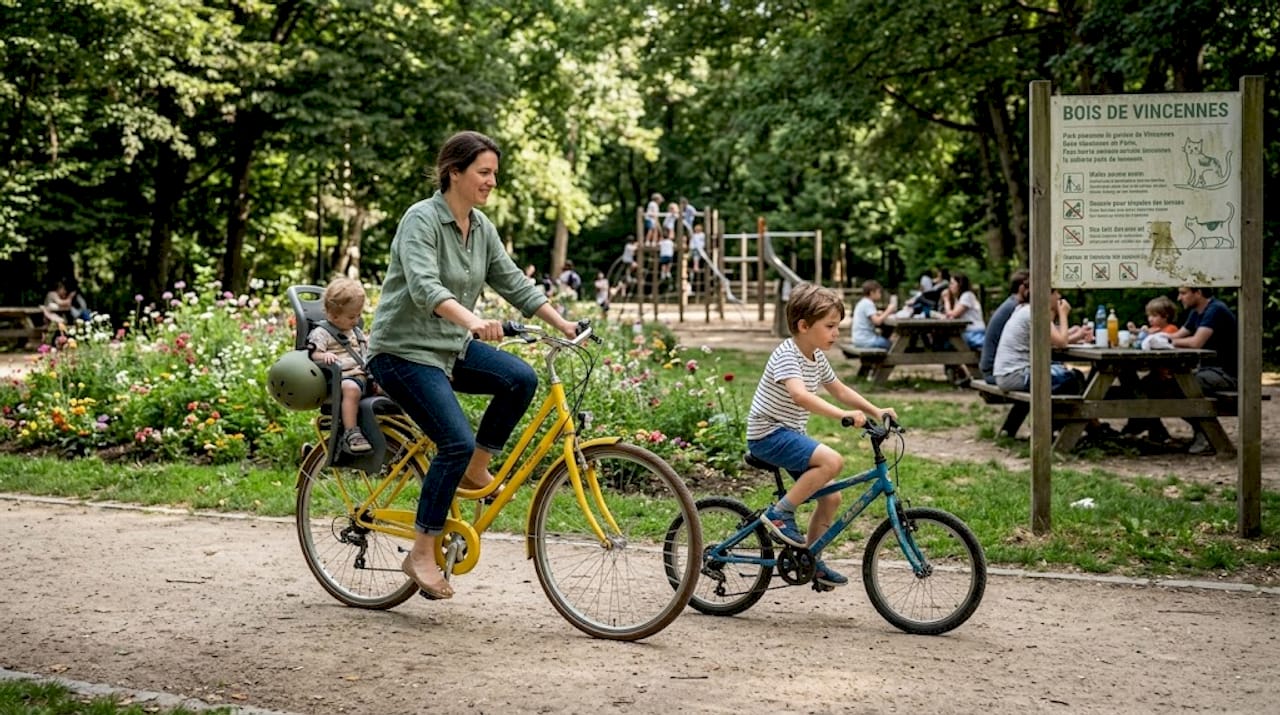
The Bois de Vincennes deserves particular mention for families with young children. The park is enormous, flat in most sections, and entirely enclosed from city traffic. Pack lunch, rent bikes at the park entrance if needed, and plan on at least three hours. You will not regret it.
Safety on the road with kids
Paris's infrastructure is good. It is not perfect. A few practical habits will make your family ride genuinely low-stress rather than just theoretically safe.
- Download Geovelo before you go. In safe route mode, the app builds routes using only protected cycle paths. This is not a minor feature. The cycle path network in Paris is complex enough to confuse newcomers, and one wrong turn can put you on a busy boulevard with no separation from traffic.
- Fit helmets before you leave the rental shop. Check that the chin strap is snug and the helmet sits level. A tilted helmet protects very little in a fall. Most Paris rental shops will adjust helmets for you if you ask.
- Lock cargo bikes to fixed objects, not each other. Cargo bikes are heavy enough to prevent casual theft, but they are not immovable. Use a quality U-lock through the rear wheel and around a fixed post.
- Plan around cobblestone zones. Wet cobblestones in Paris significantly extend braking distance, especially on cargo bikes. Check the weather forecast. If it rained the night before, add extra buffer space between you and intersections.
- Teach your children two signals before you start. A raised fist for stop and a flat palm behind the back for slow down. Simple, consistent, and visible from behind.
Pro Tip: Carry a family cycling safety checklist for the day. It sounds overcautious until you realize you forgot to check tire pressure on a cargo bike with 40 kg of children and gear in the front box.
My honest read on Paris for families on bikes
I have seen a lot of cities describe themselves as bike-friendly. Most of them mean "we painted some lines on roads." Paris is different because the change is structural and because it is still accelerating.
What I find most interesting is that the transformation was not primarily about cyclists. It was about the city deciding that car dominance was not compatible with the kind of urban life it wanted. Bikes benefited from that decision enormously, and families benefited most of all. A seven-year-old in a cargo bike box on the Seine riverbank, watching the Notre-Dame slowly come into view, is having a Paris experience that no bus tour or metro ride can replicate.
The honest challenges: the network complexity genuinely confuses newcomers, and the protected routes do not yet cover every interesting part of the city. Some neighborhoods still require careful route selection. That is why apps like Geovelo matter, and it is also why riding with a local guide for your first day is worth serious consideration. Not because you cannot manage it alone. Because someone who rides these streets every day knows which "protected" lanes are comfortable and which ones are technically compliant but feel like riding between parked delivery trucks.
The other thing families consistently underestimate: how much ground you cover. A family that would walk three km in a day will ride twelve on bikes without noticing. That changes what you can see, and it changes how tired everyone is at the end of the day. Pleasantly tired, not wrecked.
— Evgeny
Explore Paris by bike with Tres Gatos
If you want your first day on Paris bikes to feel easy rather than stressful, a guided ride takes all the route-planning weight off your shoulders.
Tresgatos runs small-group Paris bike tours with a maximum of nine people, a local guide who actually lives in the city, and everything included: bike, helmet, insurance. No surcharges. The guides know which car-free routes work best by time of day, where to stop with kids, and how to pace a group that includes a ten-year-old and two adults who have not ridden in a year. Our Paris tour page covers the full route and what to expect. If you want to skip straight to booking, you can see all available tours for Paris and our other cities. Three hours, one guide, a city that starts making sense.
FAQ
Is Paris safe for family cycling with young children?
Yes, particularly on car-free routes like the Seine riverbanks and park paths. Using the Geovelo app in safe route mode and choosing protected cycle paths keeps risk low even with very young riders.
What is the best bike for cycling in Paris with kids?
For children under six, the Urban Arrow Family cargo bike is the most practical option, with room for two children and electric assist. Older children who ride independently do well on standard or e-bikes alongside parents.
What is P'tit Velib and how do families use it?
P'tit Velib is Paris's children's bike-sharing program offering balance bikes, training wheel bikes, and geared bikes with helmets included. Families register at any Velib station terminal and pick up bikes near parks or cultural sites.
Which Paris neighborhoods are best for family cycling away from crowds?
Ménilmontant, Canal Saint-Martin, and the Bois de Vincennes are all significantly less congested than central tourist zones and offer more pleasant, safer riding conditions for families.
Do I need a special app to cycle safely in Paris with kids?
Geovelo is the most recommended navigation app for families. Its safe route mode builds routes exclusively using protected paths, which removes the guesswork of navigating Paris's complex and uneven cycling network.