
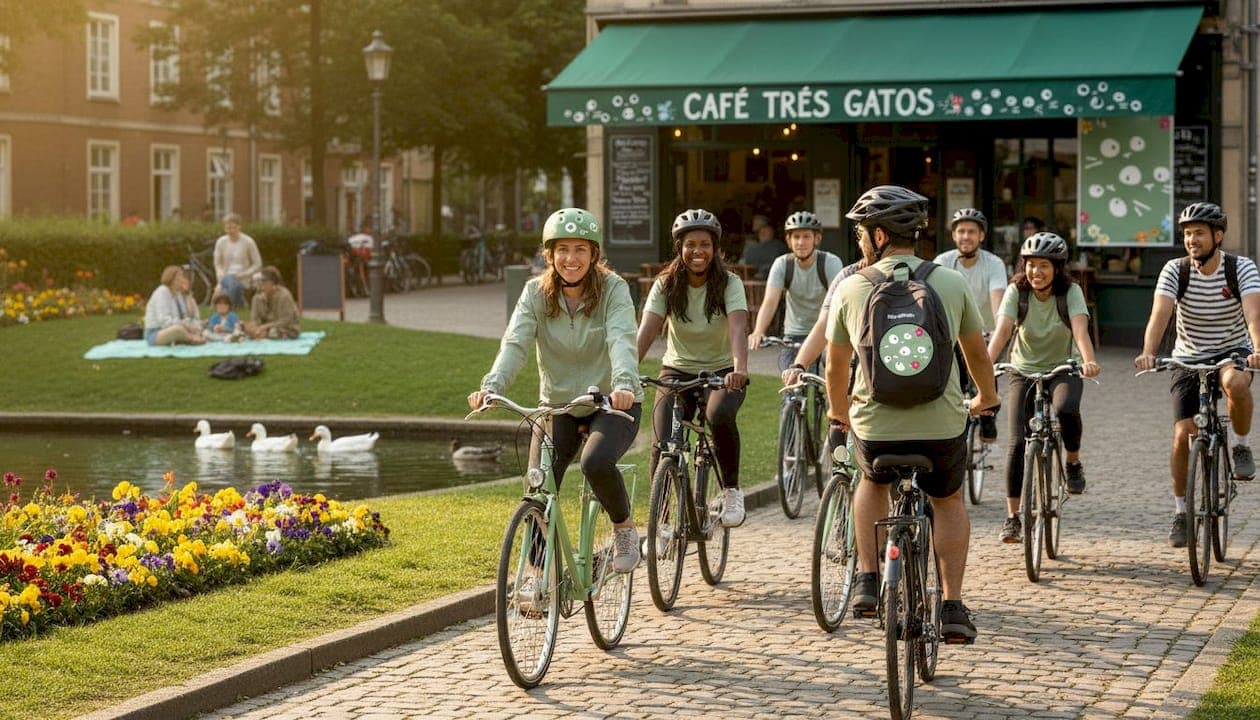
Most people assume cycling through a city like Barcelona or Paris is either thrilling or terrifying, depending on your risk tolerance. The truth is more interesting. Understanding how bike tours navigate busy city streets reveals a set of deliberate, repeatable strategies that have nothing to do with bravado and everything to do with preparation. Professional guides don't rely on luck. They rely on route knowledge, timing, communication, and a few habits that make traffic feel manageable rather than chaotic. Whether you're joining a guided tour or heading out solo, these strategies are worth knowing.
Table of Contents
- Key Takeaways
- How bike tours navigate busy city streets with predictable riding
- Route selection and timing for safer city rides
- Technology and tools for urban navigation
- Practical safety habits every urban cyclist should adopt
- Handling cobblestones, tram tracks, and mixed traffic
- My honest take on what actually works in city traffic
- Ride with someone who knows the streets
- FAQ
Key Takeaways
| Point | Details |
|---|---|
| Predictability is the core safety tool | Riding steadily and signaling clearly helps drivers anticipate your moves and reduces conflict. |
| Route selection matters more than speed | Protected lanes and quieter streets transform a stressful ride into a comfortable one. |
| Technology supports, but doesn't replace, local knowledge | GPS and offline maps reduce navigation stress, but a guide's familiarity with the city is irreplaceable. |
| Small habits create big safety margins | Taking the lane, slowing before intersections, and staying visible each reduce collision risk meaningfully. |
| Guided tours shift the mental load | When a local handles navigation and timing, you can actually look at the city instead of the road. |
How bike tours navigate busy city streets with predictable riding
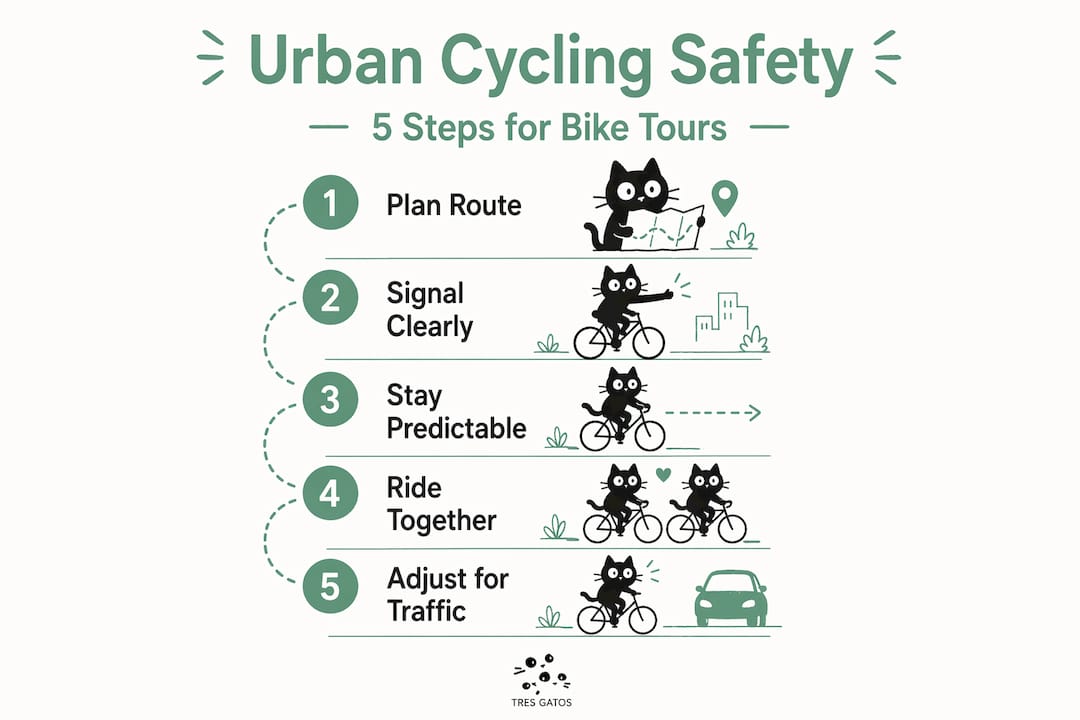
The single most effective safety tool in urban cycling isn't a helmet or a high-visibility vest. It's predictability. Cycling in traffic depends on cooperation through consistent signaling rather than hoping drivers are paying attention. Professional guides know this, and they build it into every ride from the first block.
Predictable riding means holding a steady line, maintaining consistent speed, and never weaving between parked cars and moving traffic. When you move in a straight, readable path, drivers can plan around you. When you dart unpredictably, they can't. It's that simple, and it's the foundation of how bike tours handle traffic in city centers.
Clear communication reinforces this. Good guides use hand signals before every turn, slow down before stopping rather than at the stop, and call out hazards to the group behind them. Voice signals like "stopping" or "car back" keep the whole group synchronized without anyone needing to look around.
For group rides, this matters even more:
- Signal every turn at least three seconds before making it, giving both drivers and the riders behind you time to react.
- Maintain consistent spacing within the group, typically one to two bike lengths, so the group reads as a single predictable unit to drivers.
- Avoid sudden braking by scanning ahead and easing off the pedals early when you see a red light or a pedestrian stepping out.
- Call out hazards verbally, such as "pothole left" or "tram track ahead," so the whole group can adjust without looking down.
Pro Tip: If you're joining a guided tour for the first time, watch the guide's hands for the first five minutes. Their signaling rhythm tells you everything about how the group will move together.
Route selection and timing for safer city rides
Professional bike tours don't just pick any route. They pick the right route at the right time. Local knowledge about traffic patterns and safest route timings lets guided tours reduce navigation stress and safety risks for tourists significantly. This is one of the clearest advantages of a guided experience over going it alone with a phone map.
Here's how professional guides approach route planning:
- Prioritize protected bike lanes. Physical separation from car traffic, whether by a concrete barrier, a parked car buffer, or a raised lane, removes the most common source of stress. Barcelona's Eixample grid and Paris's Seine-side lanes are examples of infrastructure that makes urban cycling genuinely comfortable.
- Avoid high-traffic corridors. Major arterial roads move cars fast and leave little room for error. Guides route around these even when it adds a few minutes, favoring parallel streets with lower speed limits and lighter traffic.
- Time rides to avoid rush hour. Morning rush (7:30 to 9:00) and evening rush (17:30 to 19:30) are when delivery vehicles, commuters, and school traffic peak simultaneously. Most city bike tours run mid-morning or early afternoon for exactly this reason.
- Use city cycling infrastructure maps. Most European cities publish official bike network maps. Barcelona's city cycling network is publicly available and updated regularly. Cross-referencing these with real-world guide knowledge fills the gaps that maps miss.
- Build in fallback options. If a street is blocked or unexpectedly busy, a good guide has an alternate route ready without needing to stop and consult a phone.
Here's a quick comparison of route types and what they mean for your ride:
| Route type | Traffic exposure | Stress level | Best for |
|---|---|---|---|
| Protected bike lane | Very low | Low | All riders, including beginners |
| Shared residential street | Low | Low to moderate | Comfortable urban cyclists |
| Painted bike lane only | Moderate | Moderate | Experienced city riders |
| Mixed traffic arterial road | High | High | Not recommended for tours |
Technology and tools for urban navigation
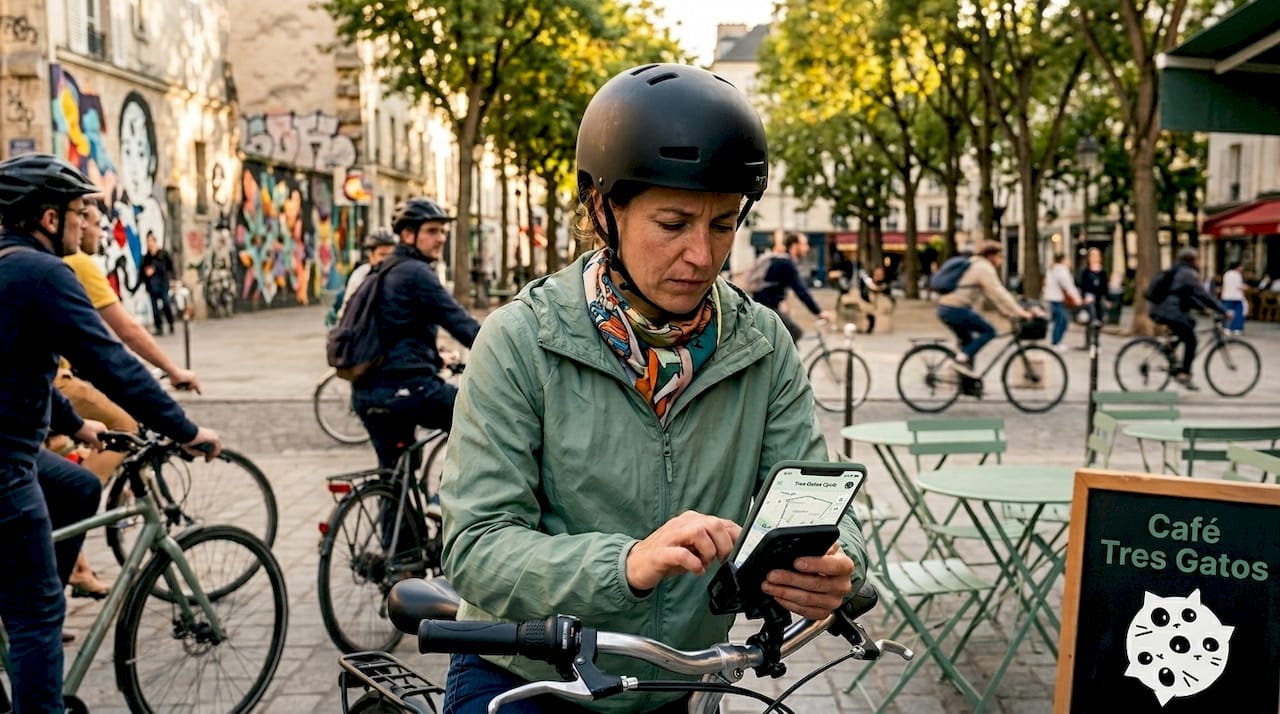
GPS and cycling apps have genuinely changed how guides and individual riders manage complex urban routes. The best tools don't replace local knowledge. They free up mental bandwidth so you can focus on what's happening around you rather than what's coming up next on the map.
Key tools worth knowing:
- Preloaded GPS routes mean the guide's device gives turn-by-turn audio cues without requiring them to look at a screen. Eyes stay on the road and on the group.
- Offline maps are a fail-safe in areas with poor signal, which includes underground sections, dense building corridors, and some historic city centers where data coverage is inconsistent.
- Community-sourced cycling apps like Komoot aggregate rider-reported data on surface conditions, hazard spots, and lane quality. This kind of crowd-sourced detail is hard to find on standard maps.
- Daytime running lights with GPS integration on some newer cycling computers can log your position while simultaneously making you more visible. Flashing rear lights help drivers detect cyclists up to 270 feet sooner, which is a meaningful margin in city traffic.
Pro Tip: Download your city's cycling map as an offline file before you ride. Even if your data connection holds, offline maps load faster and don't drain your battery with constant data requests.
The real value of technology in guided tours isn't navigation. It's confidence. When the route is preloaded and the guide knows every turn, the group moves smoothly and the experience feels effortless. That ease is engineered, not accidental.
Practical safety habits every urban cyclist should adopt
These are the habits that separate riders who feel comfortable in city traffic from those who don't. They come directly from what professional tour guides teach at the start of every ride, and they apply whether you're on a tour or cycling on your own.
- Take the lane. Riding in the center keeps you visible, out of the door zone of parked cars, and prevents drivers from squeezing past you too closely. Hugging the curb feels safer but often isn't.
- Slow down before intersections, not at them. Slowing early gives you time to scan for turning vehicles, pedestrians stepping off the curb, and cyclists coming from side streets. Reacting at the intersection is already too late.
- Skip the headphones. Hearing traffic is a critical sense for situational awareness. You hear a car accelerating behind you before you see it. If you want audio, bone-conduction headphones let ambient sound through.
- Use lights during the day. Daytime running lights reduce collision risk by up to 33%. A flashing rear light costs very little and earns a significant safety margin.
- Ride single file in traffic. Side-by-side riding might feel social, but it makes the group harder to pass safely and increases the chance of a driver making a risky maneuver.
Pro Tip: Before joining any group ride, check that your bike's brakes are responsive and your tires are properly inflated. Most guided tours include a quick bike check, but arriving prepared means you're not the one slowing the group down at the start.
Handling cobblestones, tram tracks, and mixed traffic
Cities like Barcelona and Paris have layers of history under their streets, and those layers show up as cobblestones, tram tracks, and narrow medieval lanes that no urban cycling guide fully prepares you for. These are the scenarios where many cyclists get into trouble, not on the big arterial roads, but on the charming side streets.
- Cobblestones require a looser grip and a lower tire pressure. Tensing up transfers every bump directly to your steering. Relaxing your grip and letting the bike move slightly under you smooths out the ride considerably.
- Tram tracks are the most underrated hazard in European cities. Always cross them at a 90-degree angle if possible. Crossing at a shallow angle risks your front wheel dropping into the groove, which will stop the bike and throw you forward.
- Delivery vehicles and scooters move unpredictably. In dense city centers, give them extra space and never assume a stopped delivery van will stay stopped. Drivers often pull out without checking mirrors.
- Pedestrian-heavy zones call for dismounting. Professional tours manage controlled situations by choosing the safest times and routes, but some zones are simply better walked through. Guides know which ones and plan accordingly.
Pro Tip: On cobblestone streets, stand slightly on the pedals rather than sitting. It takes weight off the saddle and lets your legs absorb the vibration instead of your spine.
My honest take on what actually works in city traffic
I've ridden with groups in Barcelona, Paris, and a handful of other European cities, and the thing that consistently surprises people is how calm a well-run tour feels. Not because the streets are quiet. They're not. But because the mental load is completely different when someone who lives in the city is making the decisions.
When I'm guiding, I'm not thinking about where to turn next. I'm watching the group, reading the traffic ahead, and adjusting pace based on what I see. That's the real value of a local guide. Not the route. The attention.
What I've also noticed is that the riders who struggle most in city traffic are the ones who try to be aggressive. Weaving, accelerating to beat lights, riding too close to the car in front. It feels faster. It isn't safer. The riders who relax, hold a steady line, and trust the signals around them almost always have a better time and arrive in one piece.
One more thing worth saying: driving culture varies enormously between cities. Barcelona drivers are used to cyclists. Paris drivers are getting there. Some cities are more forgiving of mistakes than others. A guide who actually lives there knows the difference, and that knowledge is genuinely hard to replicate with an app.
— Evgeny
Ride with someone who knows the streets
If reading this has made you want to actually get on a bike in a European city rather than just think about it, that's the right instinct. Tresgatos runs guided city bike tours in Barcelona, Paris, Madrid, and Valencia. Max nine people, three hours, one guide who lives in the city and knows the traffic patterns, the cobblestone shortcuts, and the spots worth stopping at.
Every tour includes the bike, helmet, and insurance. No hidden costs. The guide handles the route, the timing, and the navigation so you can look up from the road and actually see where you are. If you're planning a trip to Barcelona, the Barcelona bike tour is a good place to start. For Paris, the Paris highlights tour covers the city's best cycling routes with a guide who knows exactly when and where to ride. You can also browse all city tours to find the right fit for your trip.
FAQ
How do bike tours handle traffic in city centers?
Professional bike tours use predictable riding, clear hand signals, and carefully timed routes through protected bike lanes and quieter streets to keep groups safe in city traffic. The guide manages all navigation decisions so participants can focus on the experience rather than the road.
What are the safest bike paths in European cities?
Protected bike lanes with physical separation from car traffic offer the lowest stress and highest safety. In Barcelona, the Eixample grid and dedicated cycling corridors are reliable options. In Paris, the Seine-side lanes and the growing network of protected routes are well-established.
Is it safe to join a guided bike tour as a beginner?
Yes. Guided tours are specifically designed for mixed ability levels, with guides setting a pace that works for the whole group. Small group sizes, like the maximum of nine riders on a Tresgatos tour, mean the guide can monitor everyone and adjust the route if needed.
What should I wear or bring for a city bike tour?
Comfortable clothes you can move in, closed-toe shoes, and sunscreen if it's sunny. Helmets and bikes are typically included in guided tours. Leave the headphones at the hotel so you can hear the guide and the traffic around you.
How do you bike safely through cobblestones and tram tracks?
Cross tram tracks at a 90-degree angle to prevent your wheel from catching the groove. On cobblestones, relax your grip, stand slightly on the pedals, and reduce your tire pressure slightly if possible. A lower speed also helps you react to uneven surfaces before they become a problem.