
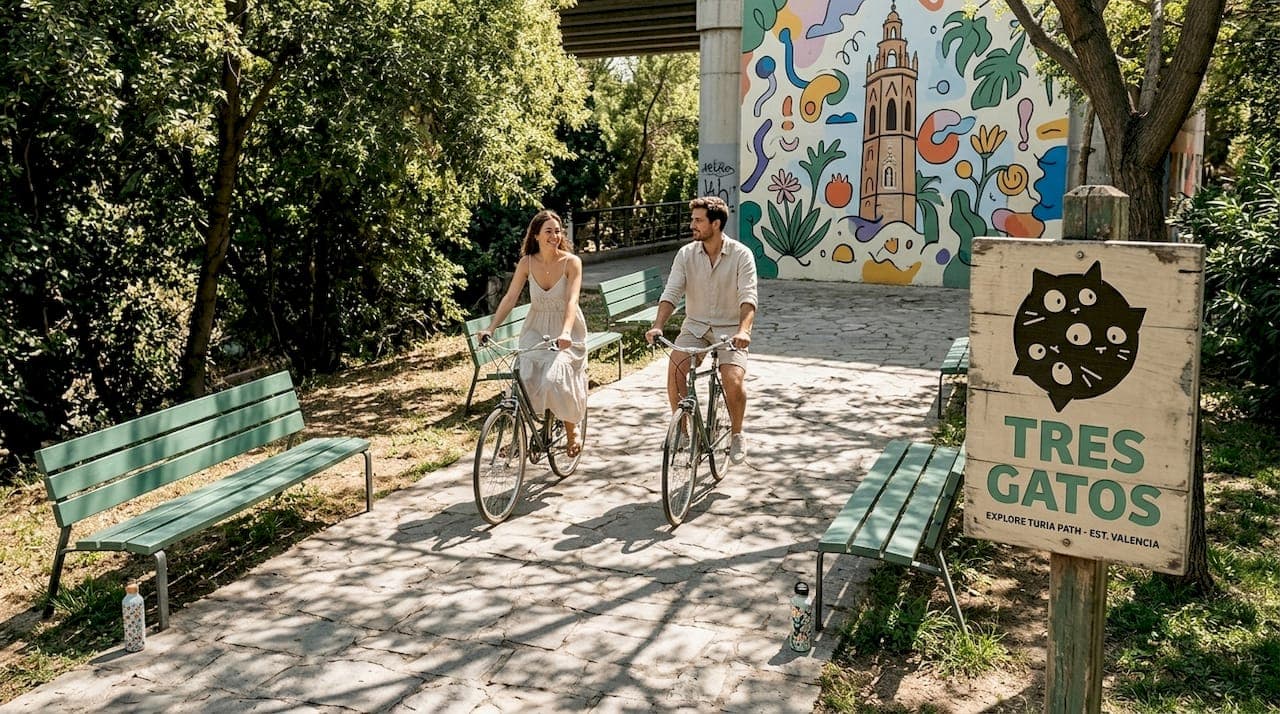
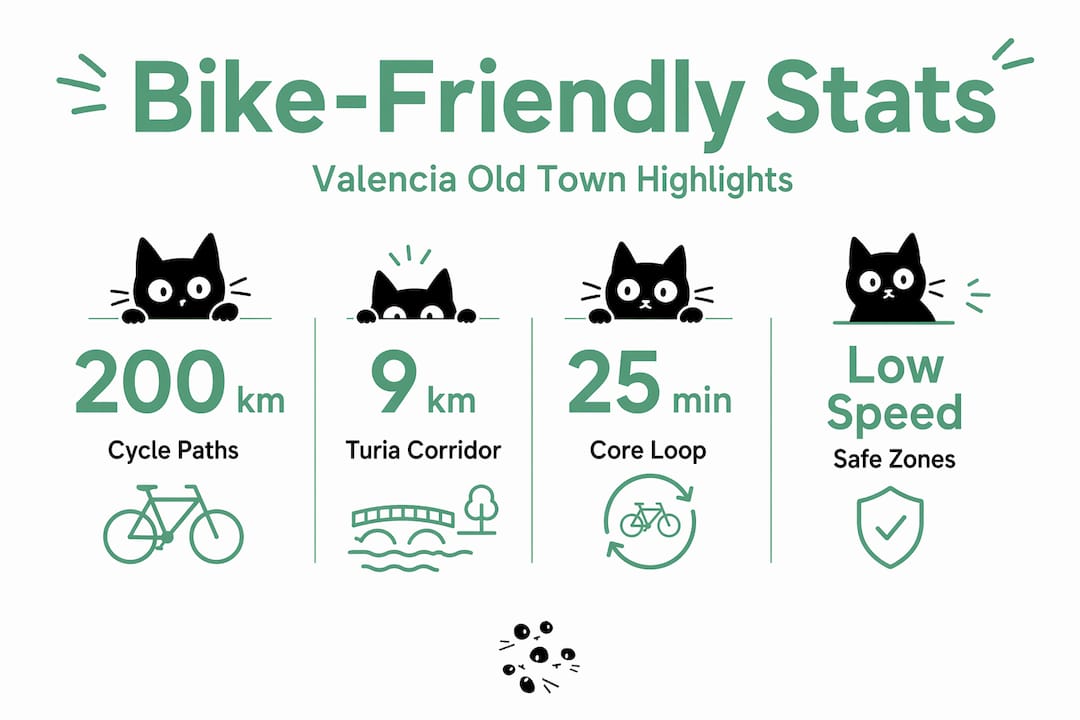
Most historic city centers punish cyclists. Cobblestones, traffic confusion, pedestrians stepping off narrow sidewalks without warning. You arrive with a rental bike feeling optimistic, and thirty minutes later you're pushing it down an alley wondering what went wrong. Valencia's Old Town is genuinely different, and why Valencia Old Town suits bike exploration comes down to a rare combination of flat terrain, a 9-kilometer traffic-free corridor running right past its landmarks, and a city government that has added over 200 km of bike lanes to its network. The setup works.
Table of Contents
- Key Takeaways
- Why Valencia Old Town suits bike exploration: the infrastructure
- The geography works in your favor
- Reaching the landmarks without the stress
- Practical tips for cycling Valencia's Old Town
- My take on Valencia's Old Town by bike
- Ride Valencia with a local
- FAQ
Key Takeaways
| Point | Details |
|---|---|
| Flat terrain reduces effort | Valencia's topography makes cycling relaxed for all fitness levels, with no notable climbs anywhere near Old Town. |
| Turia Park is the main spine | A 9 km traffic-free corridor connects Old Town landmarks directly, with no car crossings to worry about. |
| Over 200 km of bike infrastructure | The city network is dense and still growing, with major lane additions completed in 2026. |
| Segregated lanes improve safety | New bidirectional separated lanes reduce the chance of conflicting with car traffic inside and near Old Town. |
| Guided tours unlock the full picture | A local guide covers both the infrastructure and the stories behind what you're riding past, in about three hours. |
Why Valencia Old Town suits bike exploration: the infrastructure
Start with the numbers. Valencia has built around 200 kilometers of cycle paths citywide, which puts it among the better-connected cycling cities in Spain. More to the point for visitors, the network is actually usable. It's not just painted symbols on fast roads.
The single most important piece of infrastructure is the Turia Riverbed park. In the 1950s, Valencia rerouted the Turia River after catastrophic flooding and was left with a dry riverbed cutting right through the city. Instead of building a highway there (which was considered), the city turned it into a traffic-free green corridor running 9 kilometers from the western outskirts to the City of Arts and Sciences. The result is an unbroken ribbon of lawns, orange trees, and bike paths that passes within easy reach of Torres de Serranos, the Cathedral, and the Mercado Central. You can ride the whole thing without once stopping for a car.
In 2026, the city added further connections. New segregated lanes include a 1,600-meter bidirectional stretch near Sant Vicent Màrtir and a 300-meter connector on Joaquín Navarro, both improving the link between Old Town streets and the wider network. That kind of incremental expansion matters because it closes the gaps that previously forced cyclists into mixed traffic.
The key features of the current infrastructure:
- Segregated lanes physically separated from car traffic on major approach roads
- Bidirectional paths on key corridors, so you can ride toward Old Town and back on the same route
- The Turia corridor acting as a central spine accessible from multiple entry points
- Well-marked, separated bike lanes reducing confusion at intersections
Pro Tip: When you enter Old Town from the Turia corridor via Torres de Serranos, you come in through one of the most photographed medieval gates in Spain. That's not an accident. The city designed that approach.
The geography works in your favor
Some cities are charming but punishing on a bike. Lisbon's hills. Florence's cobblestones. Valencia sidesteps both of those problems.
The city is almost entirely flat, with paved surfaces throughout the cycling network. That means you're not managing gears or arriving at a plaza out of breath. You're just riding. For anyone who doesn't cycle regularly, or who wants to spend energy on the sights rather than the terrain, that makes a real difference.
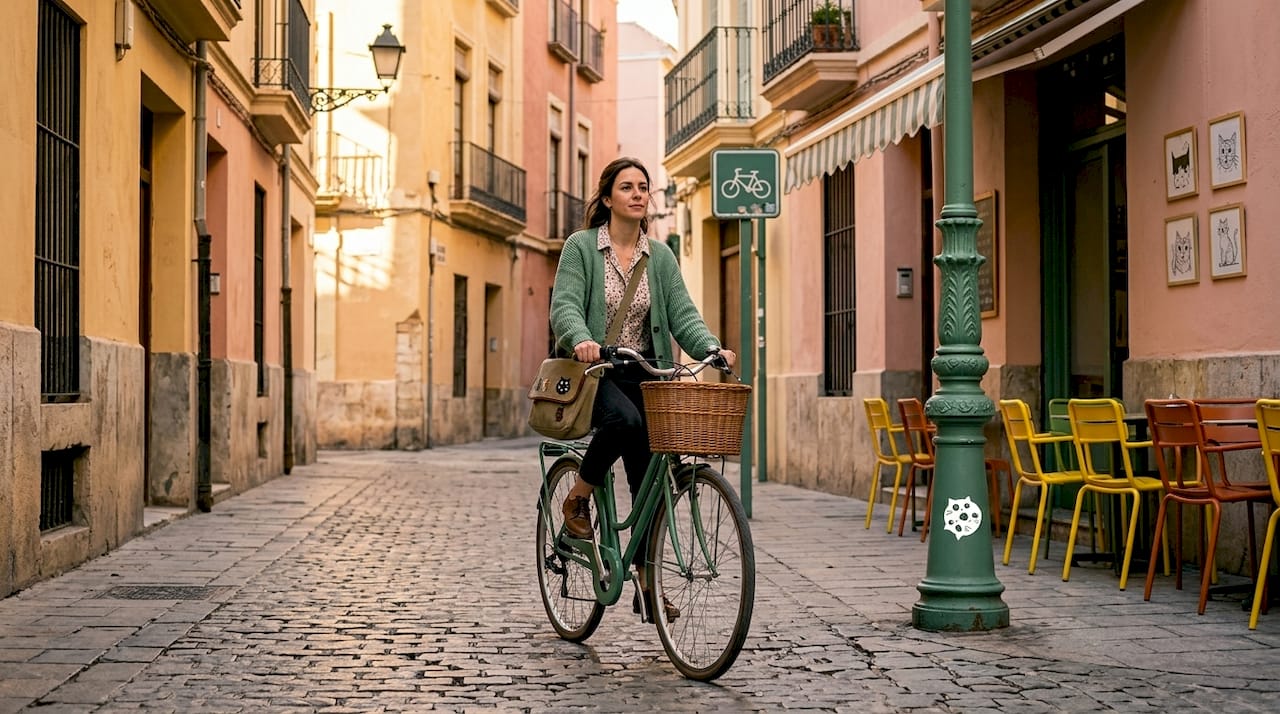
Old Town itself is compact. The core area where most landmarks sit, from the Cathedral to La Lonja de la Seda to the Torres de Serranos, covers only a few square kilometers. You can reach every major sight in a single morning without retracing your route. That compactness is something walkers appreciate too, but on a bike it means you cover the same ground in about a third of the time, which leaves room to stop longer at the places worth stopping.
Speed zones inside the historic center are also low. Large portions of the area have traffic-calming measures that bring cars down to walking pace or exclude them entirely. That low-conflict environment is what cycle-path connectivity researchers point to as the deciding factor in comfortable urban cycling. It's not just about bike lanes. It's about how rarely you have to interact with a car at all.
Pro Tip: If you're renting a bike independently, pick up in the Ruzafa neighborhood rather than the tourist center. You'll pay less, wait less, and have a pleasant ride through a real residential area before you reach Old Town.
Reaching the landmarks without the stress
Here is what a standard cycling route through Old Town and its surroundings actually looks like in practice. Most guided tours cover it in about two and a half hours, which is the right amount of time.
- Start at Turia Gardens. You pick up the corridor near the western end and immediately leave traffic behind. The path runs under shade most of the way.
- Pass Torres de Serranos. You arrive at the medieval gate from the riverbed side, which is the angle that makes most people stop for a photo. Lock your bike at the rack outside and walk through if you want to go in.
- Ride through the Carmen neighborhood. This is the oldest part of Old Town, with street art on medieval walls and a market that runs into the afternoon. Narrow here, so slow down.
- Cross to the Cathedral and La Lonja. These are close enough together that you park once and walk between them. La Lonja de la Seda is a UNESCO World Heritage Site and consistently underrated by visitors who walk past it on the way to the Cathedral.
- Continue south via the Turia corridor to the City of Arts and Sciences. Santiago Calatrava's complex sits at the eastern end of the same park. From Torres de Serranos to the glass dome of the Hemisfèric takes about 20 minutes by bike with no traffic at all.
| Route section | Bike time | Key stop |
|---|---|---|
| Turia Gardens to Torres de Serranos | 10 min | Medieval gate, city wall views |
| Carmen neighborhood loop | 15 min | Street art, Mercado Central |
| Cathedral to La Lonja | 5 min | Gothic architecture, UNESCO site |
| Old Town to City of Arts and Sciences | 20 min | Calatrava complex, Turia park end |
The bike-friendly routes that connect these sites through the Turia corridor mean you never have to backtrack through the same street twice. That's a detail that sounds minor until you've done the alternative in a different city.
Practical tips for cycling Valencia's Old Town
Good infrastructure still requires a little local knowledge. A few things worth knowing before you go:
- Lane direction matters. Not all bike lanes in Valencia run both ways. The newer bidirectional segregated lanes are clearly marked, but some older stretches are one-directional. Follow the painted arrows and you won't have problems.
- Ride early or late. The Turia corridor is popular on weekend mornings with local joggers and families. Weekday afternoons are noticeably quieter and the light is better for photos.
- Walk the narrowest sections. A few streets inside Carmen are genuinely too tight to ride safely when pedestrians are around. Locals walk their bikes there without drama. Follow their lead.
- Check for guided options. Going with someone who actually knows the route means you skip the navigation entirely and get the story behind what you're looking at. That's a different experience from solo riding, and for a first visit it's usually the better one.
Pro Tip: Combine your bike ride with short walks at La Lonja and the Cathedral. Narrow pedestrian-only zones enrich Old Town exploration in a way a bike can't replicate. Park it, go in on foot, come back.
For a broader look at how locals approach city cycling versus the tourist version, local cycling route choices in Barcelona share enough parallels with Valencia to be worth reading.
My take on Valencia's Old Town by bike
I've ridden a lot of city centers. Most of them, the honest answer when someone asks "can I bike the Old Town?" is "yes, technically, but you'll spend half the time frustrated."
Valencia is the exception I actually recommend without caveats. The Turia corridor alone changes the arithmetic. You have a direct, car-free line from the park's green spaces into the middle of a medieval city, and that is not something most European capitals can offer. Madrid doesn't have it. Barcelona doesn't have it either, at least not in the same way.
What I find interesting is that Valencia's bike infrastructure grew out of a flood disaster, not a cycling ideology. The riverbed was empty, someone decided not to fill it with asphalt, and decades later it's the reason you can ride from a Roman-era neighborhood to a Calatrava glass dome without stopping at a single traffic light. Good urban planning sometimes comes from making the most of an accident.
My honest advice: don't try to cover everything on a bike. The instinct when you have a good route is to keep moving. Resist it at La Lonja. That 15th-century silk exchange deserves twenty minutes on foot. The bike got you there faster than any alternative. Now stop and actually look.
— Evgeny
Ride Valencia with a local

Tresgatos runs small-group Valencia bike tours through Old Town and the Turia Gardens with a local guide who actually lives in the city. Three hours, nine people maximum, all equipment included. The route covers Torres de Serranos, the Carmen neighborhood, the Cathedral area, and the full Turia corridor through to the City of Arts and Sciences. No surprises on pricing, no generic commentary. Your guide knows which streets to avoid on a Saturday morning, where to stop for horchata, and why the silk exchange matters more than most people realize. If you want the full picture of safe, guided city cycling in Valencia or across Europe, that's what we do.
FAQ
Why is Valencia's Old Town good for cycling?
Valencia Old Town has a flat layout, a 9 km traffic-free corridor through the Turia Riverbed park, and over 200 km of connected bike lanes citywide. This combination makes it one of the most accessible historic centers in Europe for cycling.
How long does it take to bike Valencia's Old Town?
Most guided tours cover Old Town and the Turia Gardens in about two and a half hours. A relaxed solo ride through the main landmarks takes roughly the same time, depending on how long you stop at each site.
Is Valencia safe for cycling as a tourist?
Yes. New segregated and bidirectional bike lanes reduce car conflicts significantly, and the Turia corridor is entirely car-free. Sticking to marked, separated lanes keeps your ride low-stress throughout.
Do I need a guided tour or can I cycle solo?
Both work well. Solo riders can follow the Turia corridor easily without navigation tools. A guided tour adds local context, route knowledge, and the practical advantage of knowing exactly where to park and walk.
What landmarks can I reach by bike in Valencia Old Town?
Torres de Serranos, the Valencia Cathedral, La Lonja de la Seda, Mercado Central, and the City of Arts and Sciences are all directly accessible via connected bike routes through the Turia Gardens corridor.