
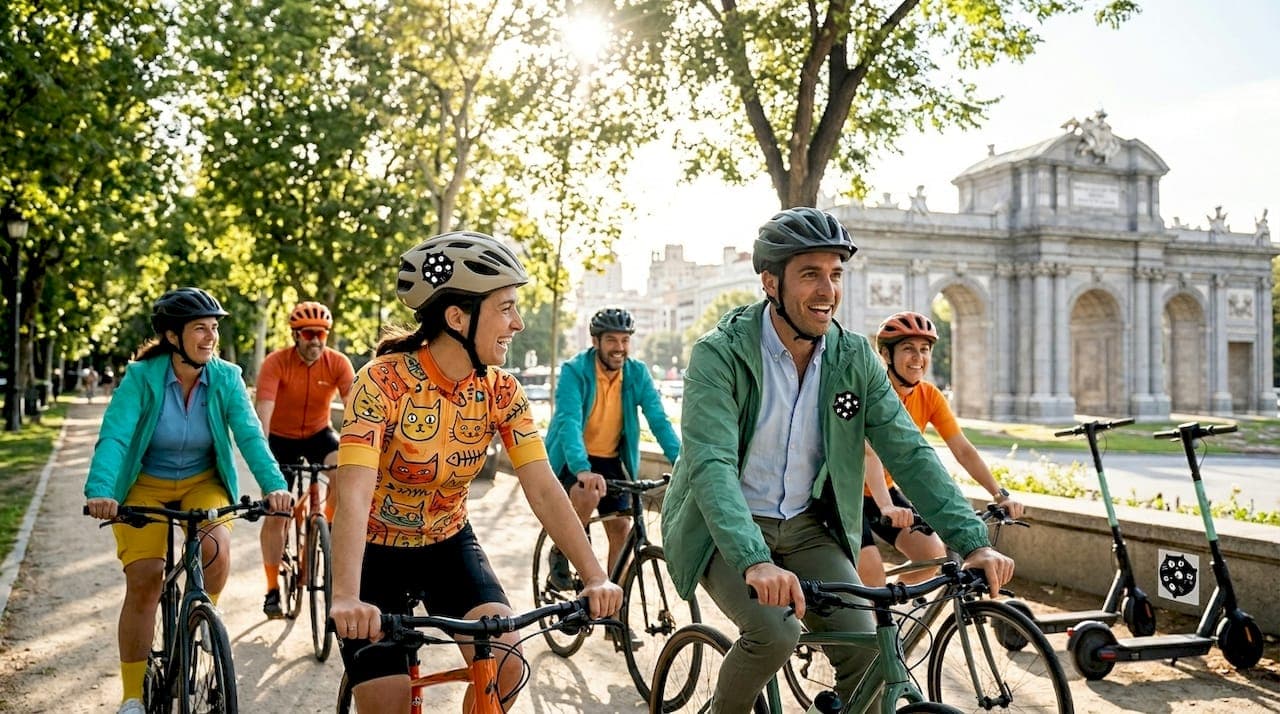
Corporate event planners looking at European cities for team cycling programs often default to Amsterdam or Copenhagen. Both are fine choices. But why Madrid suits corporate cycling events is a more interesting question, because the answer is not what most planners expect. Madrid is not a cycling city in the postcard sense. What it is, though, is a logistically sound, sustainability-aligned, infrastructure-rich hub that happens to have one of the best urban cycling corridors in southern Europe. Once you see the full picture, the city stops looking like a compromise and starts looking like a smart call.
Table of Contents
- Key Takeaways
- Why Madrid suits corporate cycling events: the logistics case
- Urban cycling infrastructure: Madrid Río and beyond
- Sustainability and regulatory incentives for cycling events
- Practical considerations for corporate cycling in Madrid
- My take on Madrid as a corporate cycling destination
- Plan your next corporate cycling event with Tresgatos
- FAQ
Key Takeaways
| Point | Details |
|---|---|
| World-class logistics hub | Madrid's airport serves 250+ international routes, making it easy to gather multinational teams in one place. |
| Traffic-free cycling corridor | Madrid Río provides a 10-km park corridor built over tunneled roads, purpose-made for group rides. |
| Sustainability compliance | Spain's Law 9/2025 means cycling events can directly support companies' legally required mobility plans. |
| Schedule-friendly city | Compact central venues and short airport transfers create genuine windows for 2-to-4-hour rides between meetings. |
| Professional guide operations | Mixed-ability teams work when pacing is managed by guides using e-bikes, not left to chance. |
Why Madrid suits corporate cycling events: the logistics case
Start with the boring stuff, because the boring stuff is what actually makes or breaks a corporate event. Getting 30 people from six countries into the same city without half a day lost to transfers is harder than it sounds.
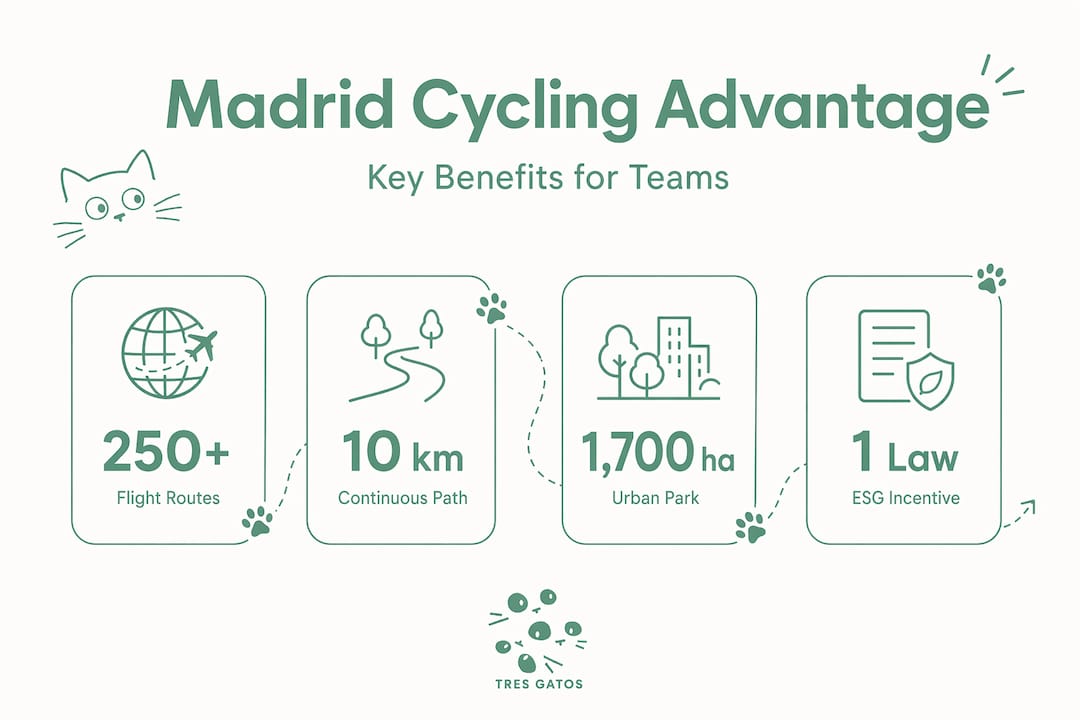
Adolfo Suárez Madrid Barajas airport connects to more than 250 routes and sits about 20 km from Puerta del Sol. That is roughly 30 minutes by metro or taxi, which means your Berlin, Paris, and London delegates can land in the same afternoon and be at the hotel before dinner. No missed starts, no half-empty cycling groups because someone's connection was delayed.
Madrid's meetings reputation is not accidental either. The city has been recognized as Europe's top meetings and conference destination, outranking cities like Singapore and Paris. That infrastructure — the conference hotels, the central venue clusters, the supplier ecosystem — directly benefits cycling events too. Everything is within reach.
Here is what that means practically for your schedule:
- Arrival and check-in on day one, followed by an evening group ride along Madrid Río
- Morning conference sessions on day two, with a two-to-four-hour cycling break in the afternoon before the dinner program
- Departure on day three, with no early-morning transfer panic
Pro Tip: Book cycling activities for mid-morning or late afternoon. Madrid's scheduling advantage over larger conference cities is that central venues and short airport distances genuinely free up time that other cities eat up in transit.
Urban cycling infrastructure: Madrid Río and beyond
Here is the part that surprises most planners. Madrid's best cycling infrastructure was not designed for commuters. It was designed as a park.
The Madrid Río project involved burying the M-30 motorway and rerouting Avenida de Portugal underground, which freed up a 10-km riverbank strip along the Manzanares. What replaced the roads is a continuous, largely traffic-free park corridor that runs through the city without a single junction to worry about. For corporate group rides, this is close to ideal.
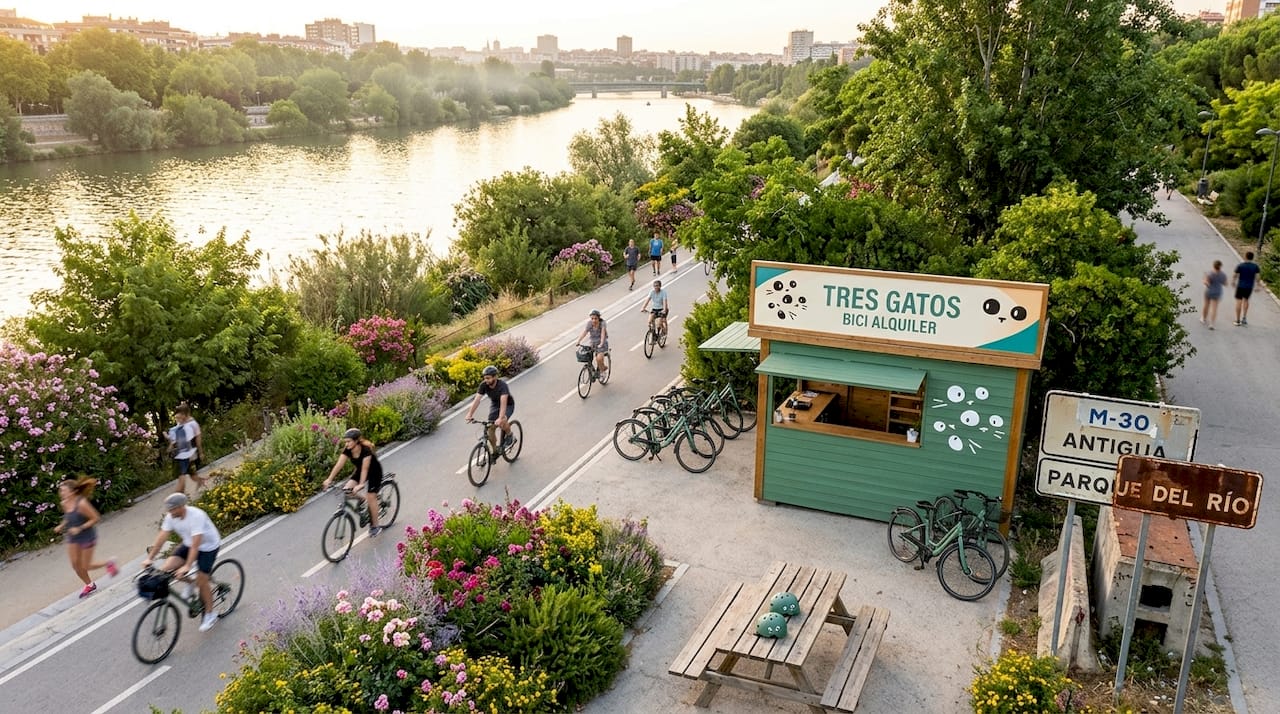
You are not threading your team through city traffic or stop-starting at crossings. You are riding a well-maintained path at whatever pace works for the group, with greenery on both sides and no cars in the picture. That design distinction matters more than any scenic route that requires mixing with traffic.
| Feature | Why it matters for corporate groups |
|---|---|
| 10-km continuous corridor | Long enough for a meaningful ride; no looping required |
| Largely traffic-free | Reduces safety complexity and participant anxiety |
| Flat terrain along the river | Accessible to mixed-ability groups without e-bikes becoming mandatory |
| Casa de Campo access | Expands into a vast wooded park for longer or split-team rides |
| Central location | Walking distance from IFEMA-area hotels is manageable by metro |
Casa de Campo, just west of the river park, adds another dimension. At roughly 1,700 hectares, it is one of the largest urban parks in Europe. That scale means you can genuinely separate groups, run relay-style team challenges, or design longer circuits for more experienced riders.
Pro Tip: Use Madrid Río for the main group ride and Casa de Campo for breakout team challenges if you have 40 or more participants. The two connect, which keeps logistics simple.
Sustainability and regulatory incentives for cycling events
This section is where corporate cycling events in Madrid stop being just fun and start being strategically useful.
Spain's Law 9/2025 on Sustainable Mobility requires companies with 200 or more employees to implement Workplace Sustainable Mobility Plans, known as WSMPs, by December 2027. These plans must prioritize active mobility, which includes cycling. If your company operates in Spain or has Spanish-registered employees, a cycling team event is not just a nice day out. It is documented evidence of active mobility promotion that can go directly into your WSMP record.
For international companies using Madrid as a conference base, the framing is different but the value is real. Here is how corporate cycling events in Madrid connect to ESG and sustainability reporting:
- Active transport promotion: A guided group ride demonstrates direct investment in active mobility, a recognized pillar in most ESG frameworks.
- Carbon footprint reduction: Madrid Convention Bureau's PLUS platform calculates event carbon footprints and produces sustainability reports aligned with UN Sustainable Development Goals.
- Supply chain alignment: Choosing a certified sustainable event destination supports Scope 3 emissions reporting for companies tracking business travel.
- Employee wellbeing metrics: Physical activity programs during corporate events increasingly feed into health and wellbeing KPIs that boards track.
The Madrid Convention Bureau's MICE Sustainability Guide gives planners a documented framework to work within, not just a vague commitment to green events. That matters when your sustainability team needs something concrete to report.
- Cycling activities can be logged as active mobility promotion under WSMP compliance documentation
- Carbon savings from replacing transfer coaches with bike routes are calculable and reportable
- Events aligned with PLUS platform reporting carry more weight in ESG audit trails
Practical considerations for corporate cycling in Madrid
Knowing the infrastructure and the policy framework is one thing. Running the actual day is another.
The single most important operational decision is how you handle mixed ability. Almost every corporate group has a spread from enthusiastic weekend cyclists to colleagues who haven't been on a bike in ten years. A well-run group ride solves this with e-bikes for those who need them and a guide who actively manages pace rather than leading from the front. The guide is not a chaperon. The guide is the person who keeps the group together without the faster riders disappearing around a corner.
A few other things that separate well-organized corporate cycling events in Madrid from chaotic ones:
- Support vehicles: A SAG vehicle running parallel to the route means anyone who needs to stop can do so without disrupting the group or creating a safety incident.
- Timing: Mid-morning starts (9-10am) and late afternoon rides (5-6pm) avoid Madrid's midday heat, particularly between May and September. Late afternoon also catches the golden light along the river, which matters for group photos that end up in company communications.
- Route design: Prioritize park corridors. A route that keeps the group in Madrid Río or Casa de Campo for 80% of the ride is a fundamentally different experience from one that uses mixed city streets. Safer, calmer, and more enjoyable for people who are not confident cyclists.
- Cultural context: Madrid has a strong café culture around cycling. Building in a stop at a riverside bar for coffee or a cold drink turns a physical activity into a social moment. That shift from exercise to conversation is often where the actual team-building happens.
If you are organizing a corporate group ride for the first time, lean on a local operator who knows the routes and the logistics. The time saved on route planning alone is worth it.
My take on Madrid as a corporate cycling destination
I have watched a lot of planners talk themselves out of Madrid. The thinking goes: "It's a busy, hot, Southern European city. Not exactly cycling country." Then they book a route through city streets, the group gets split at traffic lights, someone nearly gets clipped by a taxi, and they conclude that urban cycling events are overrated.
The issue was never Madrid. It was the route.
What I have learned from working with groups in cities across Europe is that the infrastructure question comes before everything else. Madrid Río changes the math entirely. When you take traffic out of the equation, you take most of the stress out too. What you are left with is a group of colleagues riding alongside a river with a guide who actually knows the city. That is a different product from a sightseeing tour. It is a shared physical experience in a place where the city feels genuinely present.
The sustainability angle is underused too. Most planners I talk to have not connected the dots between cycling activities and compliance documentation. Spain's mobility law is real, it has a deadline, and a well-documented cycling event with measurable participation is a concrete asset in your reporting. That framing shifts the conversation from "fun add-on" to "business-relevant program."
Madrid also rewards planners who treat it as a scheduling puzzle rather than a venue. The central location, the short airport transfer, and the compact conference district mean you have more usable hours per day than you think. A cycling session does not compete with your program. It fits into the gaps the other venues create.
— Evgeny
Plan your next corporate cycling event with Tresgatos
If you are putting together a corporate cycling program in Madrid and want a guide who actually lives in the city, Tresgatos runs small-group bike tours that work particularly well for corporate groups. Max nine people per guide. All-inclusive: bike, helmet, insurance. The guide manages pace, handles mixed ability, and knows which stretches of Madrid Río work best for groups who have not been on a bike together before.
Corporate events have run everything from informal team rides to structured team-building days through the river park. The format is flexible. The logistics are not a project: you book, we handle the route, the equipment, and the commentary. For groups larger than nine, we pair guides so the team stays together.
You can see the full tour options here or go straight to booking a tour if you already know what you need. Either way, you will not be handed a canned route and a map. You will get someone who rides this city because they choose to live in it.
FAQ
Why is Madrid a good city for corporate cycling events?
Madrid combines a world-class conference infrastructure with one of Europe's best urban cycling corridors. The Madrid Río park provides a 10-km traffic-free route that makes group rides safe and manageable for mixed-ability teams.
How does Madrid's airport help with corporate event planning?
Barajas airport serves over 250 international routes and sits about 20 km from the city center, reducing transfer time and making it practical to gather multinational teams on a tight schedule.
Can a corporate cycling event in Madrid count toward ESG reporting?
Yes. Spain's Law 9/2025 requires large companies to implement Workplace Sustainable Mobility Plans promoting active transport. A documented cycling event with participation records can directly support that compliance requirement.
What is the best cycling location in Madrid for corporate groups?
Madrid Río is the top choice for most corporate groups. It is a continuous, largely traffic-free corridor along the Manzanares river, well-maintained, and flat enough for mixed-ability riders. Casa de Campo works well for larger groups or teams who want more space.
How do professional guides improve a corporate bike ride?
A professional guide manages group pace, handles logistics on the day, and keeps mixed-ability participants together. E-bikes and support vehicles fill the gaps for participants who need more support, preventing the group from fragmenting.