
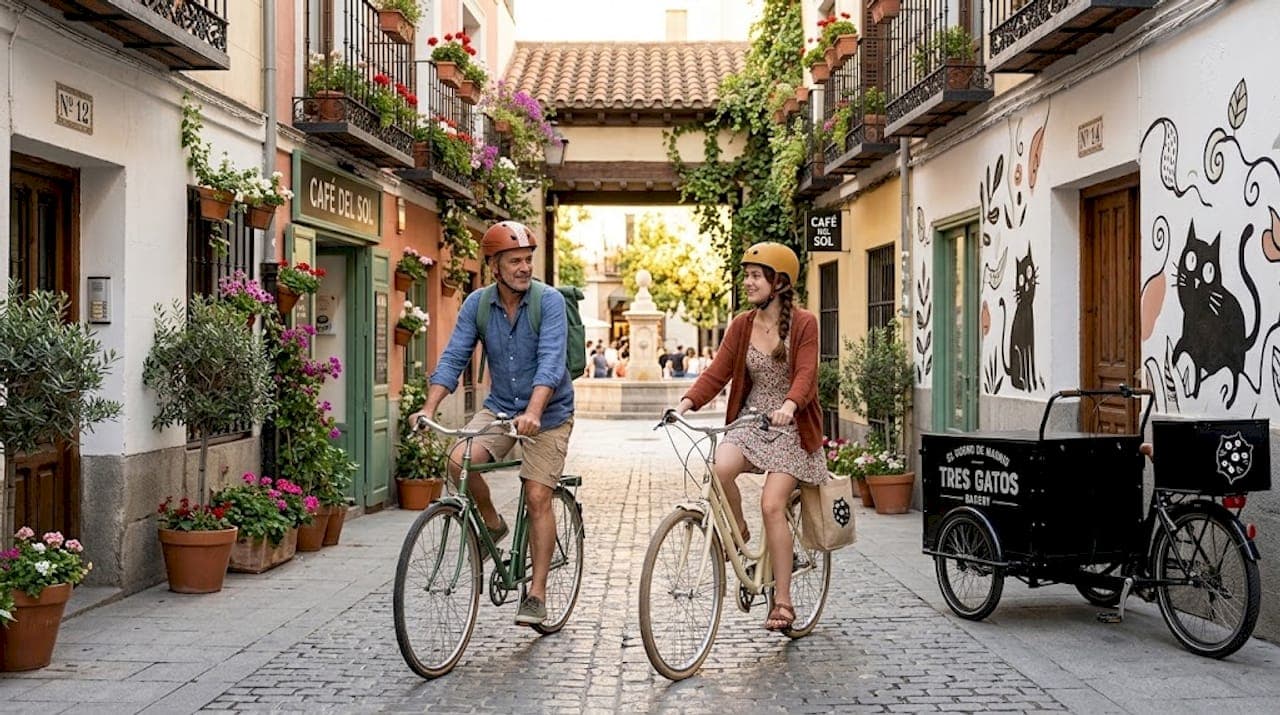
Most travelers assume historic city centers are the worst places to ride a bike. Narrow streets, crowds, cobblestones, traffic. Madrid challenges that assumption. The city's historic core is one of the more naturally suited places for cycling in Europe, and understanding why madrid historic center suits cycling changes how you plan your visit entirely. Flat terrain, compact distances between major landmarks, a maturing bike-share network, and streets that quiet down at the right hours all work in your favor. This is what you need to know before you arrive.
Table of Contents
- Key Takeaways
- Why Madrid's historic center suits cycling
- The layout: a natural loop for cyclists
- BiciMAD and the cycling infrastructure
- Navigating the challenges
- What you actually see and feel
- My honest take on cycling Madrid's center
- Ride Madrid with someone who actually lives here
- FAQ
Key Takeaways
| Point | Details |
|---|---|
| Flat terrain is a genuine advantage | Madrid's historic center is nearly level, making 10–15 km loops manageable for most travelers. |
| Landmarks form natural cycling loops | Puerta del Sol, Plaza Mayor, the Royal Palace, and Retiro Park sit close enough to connect by bike in a few hours. |
| BiciMAD makes access easy | Over 634 stations and 8,000 bikes across the center mean you rarely walk far to find a ride. |
| Infrastructure is growing but imperfect | Bike lanes now exceed 1,167 km citywide, though some routes end abruptly and require careful planning. |
| Guided tours solve the route problem | Local guides know which streets are calm, which to avoid, and when to ride versus walk. |
Why Madrid's historic center suits cycling
The first thing that surprises most visitors is the terrain. Madrid sits on a high plateau, and the historic core reflects that: it is remarkably flat. Typical bike tours cover 10–15 km in about three hours on mostly level ground. There are gentle rises near the Temple of Debod and a slight incline heading toward the Royal Palace from the river, but nothing that will leave you winded or wishing you had rented an e-bike.
Compare that to Lisbon, where the Alfama district will punish you on a standard bike, or San Francisco, where cycling the historic core is a genuine athletic undertaking. Madrid gives you the visual reward of a centuries-old city center without the physical penalty. That is a rare combination.
A few things worth knowing about the terrain before you ride:
- The area between Puerta del Sol, Plaza Mayor, and the Royal Palace is essentially flat
- Retiro Park has some gentle internal slopes but nothing steep
- The stretch along Paseo del Prado is wide and easy, even with light traffic
- Gran Vía has a very slight gradient heading west, barely noticeable on a casual ride
Pro Tip: If you are riding in summer, the flat terrain helps, but start early. By 11 a.m. in July, the pavement radiates heat and the shade disappears from the narrower streets.
The layout: a natural loop for cyclists
Puerta del Sol is Madrid's Km 0, the literal center of Spain's road network and the natural starting point for any cycling loop through the historic core. From Sol, you can reach every major landmark in the center within a short, unhurried ride. That radial structure is not an accident. It means the city was designed to connect outward from a single hub, which translates directly into cycling convenience.
Here is how a typical historic loop connects:
- Puerta del Sol — Start here. The square is pedestrianized in its core, so you walk the bike across and mount up on the edge.
- Plaza Mayor — Two minutes west. Wide, photogenic, and easy to navigate around the perimeter.
- Royal Palace and Almudena Cathedral — Another five minutes. The esplanade in front offers a long, open stretch with views toward the Casa de Campo.
- Temple of Debod — A short ride north through Parque del Oeste. This is where the terrain rises slightly, but the payoff is one of the best sunset spots in the city.
- Gran Vía — Ride back east along or parallel to the main boulevard. It is busy, but the side streets running parallel are calm.
- Retiro Park — Head southeast for a full loop inside the park, which has dedicated paths and almost no cars.
The table below gives you a rough sense of distances between key stops:
| Route segment | Approximate distance | Ride time |
|---|---|---|
| Sol to Plaza Mayor | 0.4 km | 3 min |
| Plaza Mayor to Royal Palace | 0.9 km | 5 min |
| Royal Palace to Temple of Debod | 1.2 km | 7 min |
| Sol to Retiro Park (main entrance) | 1.8 km | 10 min |
| Full historic loop (all stops) | ~10–12 km | ~2.5–3 hrs |
The compactness is the point. You are not grinding through suburban sprawl to reach the next sight. Everything is close, and the streets between them are often worth the ride themselves.
BiciMAD and the cycling infrastructure
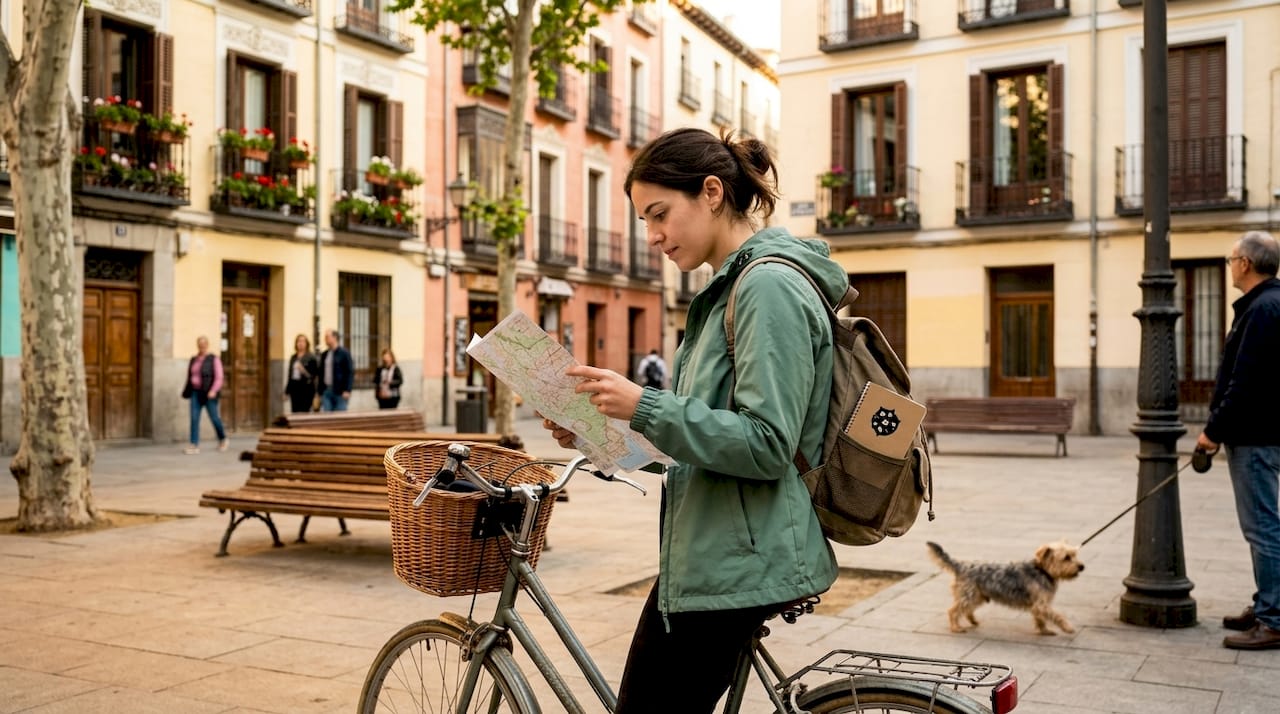
Madrid's public bike-share has grown significantly. BiciMAD reached approximately 14 million trips in 2025, with 634 stations and around 8,015 bikes as of early 2026. Station density in the historic center is high enough that you rarely need to walk more than a few blocks to find one. For travelers, that removes the logistics problem of renting and returning a bike at a single fixed location.
The broader network has also expanded. Madrid's bike lanes now cover over 1,167 km, including 764 km of segregated lanes, with the network growing 11.4% since 2019. That is real infrastructure, not a token gesture.
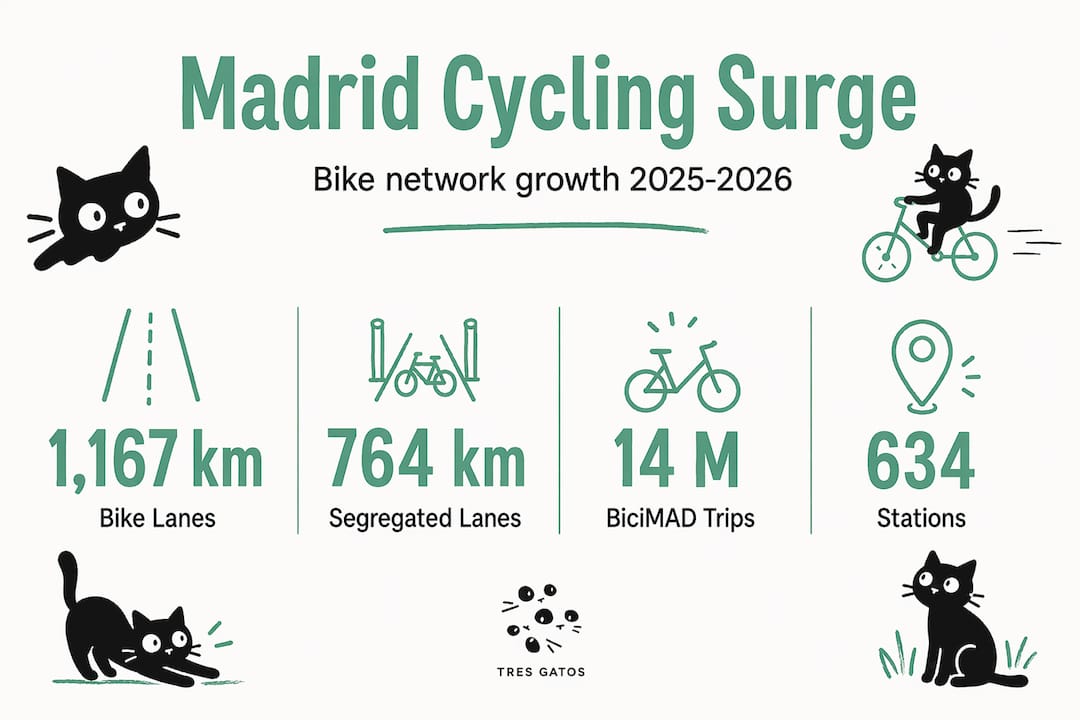
| Metric | Figure (2025–2026) |
|---|---|
| Total bike lane network | 1,167 km |
| Segregated bike lanes | 764 km |
| BiciMAD stations | 634 |
| BiciMAD bikes available | ~8,015 |
| Annual trips (2025) | ~14 million |
The honest caveat: the network is still a work in progress. Bike lanes end abruptly in places, and intersections with bus lanes require attention. The growth is real, but so are the gaps. Knowing this going in helps you ride more confidently rather than being caught off guard.
Pro Tip: Use BiciMAD station locations as your route anchors rather than following official bike lane maps. Real-world cycling in Madrid works better when you plan around station hops and connected streets than when you try to stick rigidly to marked lanes.
Navigating the challenges
No historic city center is perfect for cycling, and Madrid is no exception. Cycle paths are sometimes ignored by locals, and intersections with buses demand real attention. The infrastructure quality varies block by block. Some stretches feel smooth and protected; others drop you into a busy road with no warning.
A few practical points to keep in mind:
- Avoid Gran Vía itself during peak hours. The parallel streets, Calle de las Infantas or Calle de Hortaleza, are far calmer and run in the same direction.
- In the densest pedestrian zones around Sol and Plaza Mayor, walk your bike. It is faster than weaving through crowds and avoids friction with pedestrians.
- Guided tours plan routes through parks, quiet streets, and pedestrian areas deliberately, mixing short rides with walking in denser sections. That hybrid approach is genuinely the smartest way to see the center.
- Early mornings on weekends are the best time to ride. The streets are quiet, the light is good, and the city feels like it belongs to you for an hour or two.
- Watch for delivery vehicles in the morning. They use bike lanes casually.
The urban cycling safety basics apply here too: stay visible, signal clearly, and do not assume drivers have seen you at intersections.
What you actually see and feel
This is where Madrid earns its reputation. Cycling through the historic center is not just a logistical choice. It is a genuinely good way to experience the city.
Riding from the Royal Palace esplanade toward the Temple of Debod at dusk, with the sky turning orange over the Casa de Campo, is one of those city moments that is hard to replicate on foot or from a taxi window. The pace of a bike puts you close enough to read the menus chalked outside the bars on Calle de la Cava Baja, hear the conversation spilling out of a café on a side street near Plaza de la Villa, and catch the smell of churros from a street cart near Sol.
"Slow travel by bike through Madrid's historic core offers a unique immersive experience blending exercise, sightseeing, and local life." — Forbes, 2026
BiciMAD stations near museums and parks have even been integrated into cultural events, with bikes deployed near major museums on Día de los Museos. The city is actively weaving cycling into its cultural life, not just its commuter infrastructure. For a traveler, that matters. It means the city is set up for you to arrive by bike and feel like you belong there.
My honest take on cycling Madrid's center
I have ridden a lot of historic city centers. Some are genuinely easy, some are brutal, and a few are just not worth the effort on a bike. Madrid falls clearly in the first category, though not without conditions.
What I have found is that the quality of your ride depends almost entirely on when you go and which streets you choose. The same route that feels relaxed at 8 a.m. on a Sunday can feel genuinely stressful at noon on a Saturday. Early mornings and evenings consistently deliver the best experience. The city is quieter, the temperature is lower, and the light is better for everything you are trying to see.
The other thing I would say: do not force yourself to stay on the bike the whole time. The best rides I have had in Madrid's center are the ones where I locked up near Plaza de la Paja, walked through the market, then picked up again toward Lavapiés. The bike is a connector, not a constraint. Use it to cover ground, then walk when the streets demand it.
Madrid's cycling culture is shifting. It reflects a broader urban move toward sustainable mobility across Spanish cities, and the infrastructure is catching up, slowly but genuinely. For now, the city rewards riders who are flexible, curious, and willing to mix modes. That is not a compromise. That is just good travel.
— Evgeny
Ride Madrid with someone who actually lives here
If you want to get the most out of cycling in Madrid's historic center without spending your first hour figuring out which streets to avoid, a guided tour makes a real difference.
Tresgatos runs small-group bike tours in Madrid with a maximum of nine people and one guide who lives in the city. Three hours, a bike, a helmet, insurance, and no extra charges. The guide knows where the lanes end, which squares are calm at which hours, and what is worth stopping for. You cover the Royal Palace, Plaza Mayor, Retiro Park, and the streets in between at a pace that lets things actually register. Book your spot here and show up ready to ride.
FAQ
Is Madrid's historic center flat enough for casual cyclists?
Yes. The historic core is nearly level, with only very gentle rises near the Temple of Debod and the Royal Palace approach. Most guided tours cover 10–15 km in about three hours without significant climbing.
How does BiciMAD work for tourists?
BiciMAD is Madrid's public bike-share with 634 stations and around 8,000 bikes across the city. You can register with a credit card at any station kiosk or via the app, and return the bike to any other station when you are done.
What are the safest cycling routes in Madrid's historic center?
The safest routes run through Retiro Park, along Paseo del Prado, and on the quieter streets parallel to Gran Vía. Guided tours deliberately route through parks and low-traffic streets while mixing cycling with short walking sections in the densest pedestrian zones.
When is the best time to cycle in Madrid's historic center?
Early mornings and evenings work best. Timing your ride for before 10 a.m. or after 7 p.m. gives you quieter streets, better light, and cooler temperatures in summer.
Do I need a guided tour or can I ride independently?
Both work, but independent riders should plan routes in advance using BiciMAD station locations as anchors rather than relying on official lane maps alone. A guided tour is the faster way to get a good ride on your first day, since the guide handles all route decisions in real time.